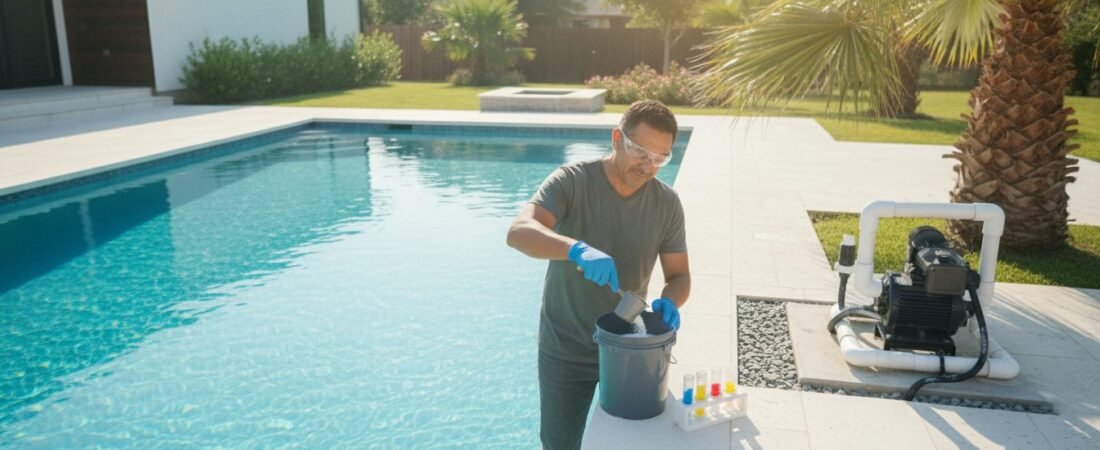
What if the most intimidating chemical in your pool shed is actually the one that keeps your family the safest? For many homeowners in Katy and Fulshear, handling a powerful liquid like muriatic acid feels like a high-stakes science experiment. You likely already know that keeping your water clear requires more than just a handful of chlorine tabs. You’ve probably felt the sting of itchy eyes after a swim or noticed that stubborn, white crusty buildup forming on your tiles. These aren’t just minor nuisances. They’re signs that your water chemistry is drifting out of alignment. To fix it, you need to understand exactly what does muriatic acid do for pools and how it functions as a precision tool for balance.
This methodical guide will demystify the process of chemical stabilization so you can protect your investment. We’ll explain how muriatic acid lowers pH and alkalinity to prevent equipment damage to your expensive heaters and pumps. You’ll learn to manage the unique challenges of the Houston heat with a disciplined, step-by-step approach. By the end, you’ll have the confidence to maintain a safe, crystal-clear swimming environment that feels as good as it looks. We’re moving beyond guesswork to focus on the technical accuracy and steady maintenance your pool deserves.
Key Takeaways
- Understand exactly what does muriatic acid do for pools by learning how it stabilizes pH and Total Alkalinity to keep water comfortable and clear.
- Discover why maintaining the alkalinity anchor is essential for preventing rapid pH swings that lead to equipment corrosion or scale buildup.
- Learn why liquid muriatic acid is often superior to dry acid alternatives, which can introduce harmful sulfates into your pool water over time.
- Master the AAA safety rule and essential protective measures to handle this powerful chemical with the precision and care of a professional.
- Explore how to use acid for specialized maintenance tasks like removing stubborn calcium scale and extending the life of your salt chlorine generator cells.
What is Muriatic Acid and Why is it Used in Swimming Pools?
Muriatic acid is a simplified name for a diluted form of hydrochloric acid. While the word “acid” might sound alarming to a new pool owner, it’s actually a foundational component of professional water maintenance. It isn’t a sign that something has gone wrong with your water; rather, it’s the primary tool used to keep your chemistry within safe, predictable limits. While chlorine acts as the sanitizer that kills bacteria and algae, muriatic acid serves as the balancer. It manages the environment so your sanitizer can do its job effectively. Without it, the intense Texas sun and heavy bather loads in Katy and Houston would quickly push your water into an unstable state.
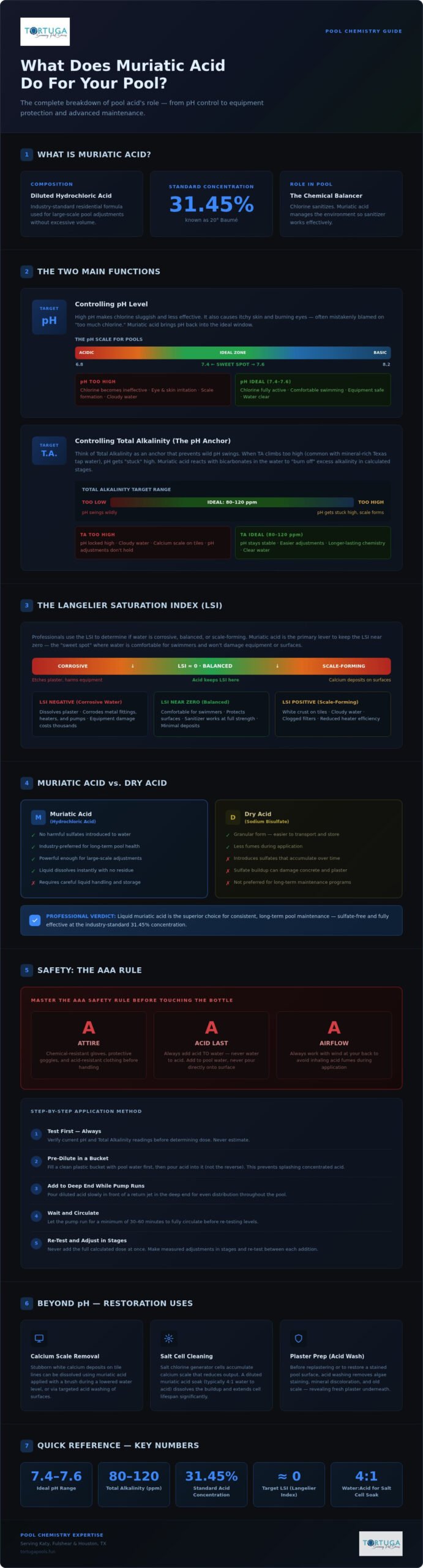
The primary answer to what does muriatic acid do for pools involves two specific measurements: pH and Total Alkalinity. It’s a high-strength liquid designed to lower these levels when they climb too high. High pH makes chlorine sluggish and less effective, while high alkalinity can lead to cloudy water and scale. By adding acid in precise, measured doses, you’re performing a controlled chemical adjustment that protects your pool’s surface and your family’s comfort.
The Chemical Composition of Pool Acid
Most muriatic acid sold for residential pools comes in a concentration of 31.45%, also known as 20° Baume. This specific strength is the industry standard because it’s powerful enough to make large-scale adjustments in a 20,000-gallon pool without requiring massive quantities of liquid. Because of its potency, handling it requires a steady hand and a disciplined process. Understanding the concentration is the first step in avoiding common pool chemical mistakes that can lead to etched plaster or damaged equipment. We prioritize accuracy over estimation; every gallon of water deserves a verified dose based on current test results.
The Relationship Between Acid and Water Comfort
Many swimmers complain about “too much chlorine” causing itchy skin or burning eyes. In reality, the culprit is often a high pH level that muriatic acid failed to correct. When your pH rises above the recommended 7.4 to 7.6 range, the water becomes slightly basic. This shift irritates human mucous membranes and skin. Professionals use the Langelier Saturation Index (LSI) to determine if water is corrosive, balanced, or scale-forming. Muriatic acid is the lever we pull to keep the LSI near zero. Maintaining this “sweet spot” ensures the water is physically comfortable for swimmers while remaining chemically aggressive enough to prevent minerals from plating out onto your tiles. It’s a methodical balance that requires consistent testing and a commitment to long-term pool health.
The Two Main Functions: Balancing pH and Total Alkalinity
In the Katy and Fulshear areas, our local tap water is notoriously rich in minerals. This creates a constant upward pressure on your pool’s chemical levels. To understand what does muriatic acid do for pools, you must view it as the essential counter-weight in a chemical tug-of-war. Without consistent, measured acid additions, your pH and alkalinity will inevitably climb. This drift leads to the visible signs of unbalanced pool water, such as cloudy surfaces and white calcium deposits on your tile line. Professionals use muriatic acid to keep these levels in a state of stable equilibrium.
The relationship between these chemicals is often called the “pH Seesaw.” When one side goes too high, the entire system loses its effectiveness. If you ignore this balance, you aren’t just dealing with uncomfortable water. You’re allowing a environment where your pool’s mechanical components are at risk. A methodical approach to acid application prevents these issues before they require expensive repairs.
Controlling Total Alkalinity
Think of Total Alkalinity (TA) as a buffer or an anchor. Its primary job is to keep your pH from bouncing around too wildly. However, in our local climate, TA often drifts well above the ideal range. When this happens, your pH gets “stuck” at a high level, making it difficult to adjust. Muriatic acid reacts with the bicarbonates in the water to effectively “burn off” this excess alkalinity. We take a disciplined approach here. We don’t simply dump acid into the deep end. We add it in calculated stages to bring the TA down to the ideal 80 to 120 ppm range without causing the pH to crash and damage your heater’s copper core. For a complete walkthrough of this process, our guide on how to lower alkalinity in pool water using the acid-and-aerate cycle provides the precise, science-backed steps you need.
Optimizing Chlorine Effectiveness
There’s a direct, inverse relationship between your pH level and how well your chlorine actually works. When pH is high, chlorine becomes sluggish. At a pH of 8.0, your chlorine is approximately 80% less effective than it would be at a pH of 7.2. You might be spending a fortune on chlorine tabs, but if your pH isn’t controlled with muriatic acid, that chlorine isn’t killing bacteria or algae efficiently. By keeping your pH in the 7.4 to 7.6 range, you ensure your sanitizer stays active and powerful. This technical accuracy saves you money and keeps the water safe for your family. If keeping up with these weekly adjustments feels overwhelming, our weekly chemical balancing provides the steady hand needed to maintain a healthy pool all year long.
Muriatic Acid vs. Dry Acid (Sodium Bisulfate): Which is Better?
Homeowners often face a choice between liquid muriatic acid and granular dry acid, also known as sodium bisulfate. While dry acid is often marketed as a safer, more convenient alternative, it carries hidden long-term consequences for your pool’s infrastructure. To truly understand what does muriatic acid do for pools, you must compare its chemical purity to the byproducts left behind by dry alternatives. In the Houston area, where many pools utilize salt chlorine generators and decorative stone, the choice of acid can determine the lifespan of your most expensive equipment.
The primary issue with dry acid is the “Sulfate Problem.” Every time you add sodium bisulfate to lower your pH, you are introducing sulfates into the water. Unlike other chemicals that dissipate or get filtered out, sulfates accumulate. Once levels exceed 300 parts per million (ppm), they become aggressive. High sulfate concentrations are known to damage the protective coating on salt cells and can lead to the degradation of stone surfaces and grout. Professional technicians almost exclusively use liquid muriatic acid because it leaves no such residue, ensuring the water remains chemically “clean.” Salt system owners dealing with these challenges will find that many of the common salt water pool problems like persistent high pH and calcium scale are directly tied to the choice of acid used for routine balancing.
Pros and Cons of Liquid Muriatic Acid
Liquid muriatic acid is the industry standard for several reasons. It reacts immediately with the water, providing instant results for pH and alkalinity adjustments. It’s also highly cost-effective for the large residential pools common in Katy and Fulshear. However, it requires a disciplined approach to safety. The fumes are strong and can be irritating if inhaled, and the liquid itself is highly corrosive to skin and clothes. It must be stored in a cool, well-ventilated area away from other chemicals like chlorine. For those who prioritize chemical purity and equipment longevity, the benefits of liquid acid far outweigh the handling requirements.
When to Consider Dry Acid
There are rare situations where a homeowner might choose dry acid, specifically when the risk of a liquid spill on a sensitive surface outweighs chemical efficiency. If you don’t have a secure area to store liquid containers, the granular form is easier to manage. However, you must account for the rise in Total Dissolved Solids (TDS). As TDS climbs, the water becomes “older” and less responsive to treatment. We prefer the methodical precision of liquid muriatic acid. It allows us to maintain a stable environment without the risk of sulfate-driven corrosion. By choosing the right tool for the job, you protect your pool’s health for years rather than just fixing a number on a test strip today.
Safety and Application: How to Use Muriatic Acid Methodically
Handling muriatic acid is a task that demands your full attention. It is not a chemical to be used casually or with guesswork. When you understand what does muriatic acid do for pools, you realize that its power to balance water is matched by its potential to cause harm if handled incorrectly. A methodical safety routine is the only way to ensure a stable environment for your family and your property. We treat every chemical addition with the same level of care as a technical repair, prioritizing long-term safety over speed.
The most critical safety protocol in the industry is the “AAA” rule: Always Add Acid to water. You should never pour water into a container of acid, as this can cause a violent chemical reaction and dangerous splashing. Before you even open the bottle, put on your Personal Protective Equipment (PPE). This includes acid-resistant gloves, safety goggles that seal against the face, and closed-toe shoes. Even a small drop can cause significant skin irritation or damage to pool decking. Precision starts with protection.
Step-by-Step Application Guide
Accuracy is the hallmark of a professional. Before adding any chemical, test your water with a high-quality liquid reagent kit. Test strips are often too vague for the precision required here. Once you have an accurate reading, calculate your dose based on your pool’s total gallonage. When you are ready to pour, ensure the pool pump is running. Pour the acid slowly in front of a return jet to help it circulate quickly. Avoid pouring directly into the skimmer; the concentrated acid can damage your filtration system or heater. Wait at least four hours with the pump running before retesting the levels or allowing anyone to swim.
Texas-Specific Safety Tips
The 100-degree humidity in Katy and Fulshear presents unique challenges. On stagnant, humid days, acid fumes tend to linger near the ground rather than dissipating. Always stand upwind when pouring and keep your face away from the bottle’s opening. Storage is equally important. Never store muriatic acid in a completely sealed, unventilated hot garage or near your pool heater and pump. The fumes can corrode metal components even through plastic caps. Keep it in a cool, dedicated chemical bin away from children, pets, and chlorine products. Mixing acid and chlorine creates a toxic gas that is immediately life-threatening. If you prefer to leave these technical details to the experts, our weekly cleaning and maintenance service ensures your pool stays balanced without the risk.
Beyond pH: Using Muriatic Acid for Pool Restoration
When people ask what does muriatic acid do for pools, they often forget its role as a restorative agent. In the Katy and Fulshear areas, our source water is naturally high in calcium. This often leaves a stubborn, “white line” deposit on your tile or stone. When applied with precision, acid dissolves these minerals without damaging the grout. It’s also the essential tool for cleaning salt chlorine generator cells. Over time, these cells calcify; a methodical acid bath restores their efficiency and saves you from a premature replacement. Understanding how cell calcification fits into the broader picture of common salt water pool problems helps you stay ahead of the maintenance curve before costly repairs become necessary.
For more severe cases, an “Acid Wash” might be necessary. This involves draining the pool and applying a concentrated acid mixture to strip a microscopic layer of plaster. This process reveals the fresh, unstained surface underneath. Because this involves highly concentrated fumes and the risk of etching the plaster too deeply, it’s a task that requires professional pool repair expertise. Our team also ensures that all acid is neutralized before disposal, adhering to local guidelines for Harris and Fort Bend counties. It is a restoration tool, not a DIY weekend project.
Protecting Your Equipment
The damage from high pH isn’t always visible. Inside your pool heater and pump, scale buildup acts like a restrictive plaque. It forces your motor to work harder, which can lead to common signs of a failing pool pump such as overheating or reduced flow. By understanding what does muriatic acid do for pools, you see it as a vital preventative measure. It’s much cheaper to dose a few cups of acid weekly than it is to replace a $2,000 heater or a high-efficiency pump. Chemical stabilization is mechanical protection.
The Tortuga Method: Professional Chemical Stewardship
At Tortuga Pools, we don’t believe in “quick fix” chemistry. Our weekly service is built on a foundation of methodical craftsmanship. We treat your Katy home with the same diligence we apply to our own. By handling the storage, measurement, and application of muriatic acid, we take the risk and the guesswork off your plate. You get the benefit of professional-grade testing and a steady hand. It’s about more than just clear water. It’s about long-term pool health and neighborly accountability. Let us manage the technical details so you can enjoy the water.
Achieving Long-Term Stability for Your Swimming Environment
Maintaining a pool in the persistent Texas heat requires more than just skimming the surface. It demands a disciplined approach to water chemistry. You now understand exactly what does muriatic acid do for pools. It acts as the primary stabilizer for pH and alkalinity. This methodical balancing prevents the stubborn calcium scaling that ruins tiles and the silent corrosion that destroys expensive heaters. It’s about prioritizing technical accuracy over guesswork to protect your investment and your family’s comfort. We believe that consistency is the key to longevity.
If the complexities of acid handling and water testing feel overwhelming, we’re here to assist. Let Tortuga Pools handle the chemistry for you; schedule your weekly maintenance today. We provide expert Katy and Fulshear local service rooted in methodical weekly chemical balancing. Our process uses precise science to protect your equipment and keep your water inviting. Enjoy the confidence that comes with a professionally maintained home. Your crystal-clear retreat is ready for you.
Frequently Asked Questions
Is muriatic acid safe to use in salt water pools?
Yes, muriatic acid is essential for salt water pools because the electrolysis process naturally raises the water’s pH over time. Without regular acid additions, your salt cell will quickly develop calcium scale, reducing its efficiency and lifespan. Using liquid acid is actually preferred over dry acid in these systems to avoid sulfate buildup. It’s a key part of what does muriatic acid do for pools by keeping the cell clean and the water balanced.
How long after adding muriatic acid can I swim?
You should wait at least 30 to 60 minutes after adding muriatic acid before entering the water. However, waiting a full four hours with the pump running is the professional recommendation for complete circulation. This ensures the acid is fully diluted and won’t cause hot spots that irritate skin or eyes. Always retest the pH level before swimming to verify the water has reached the desired 7.4 to 7.6 range for safety.
Can muriatic acid damage my pool liner or plaster?
Muriatic acid can damage your pool’s surface if it isn’t applied with a methodical approach. If concentrated acid settles on the bottom, it can etch plaster or cause vinyl liners to become brittle and crack. You must always add acid while the pump is running to ensure immediate mixing. Pouring it slowly in front of a return jet prevents the chemical from making direct, prolonged contact with the pool floor or walls.
What happens if I add too much muriatic acid to the pool?
Adding too much acid causes the pH and Total Alkalinity to crash, making the water highly corrosive. This acidic environment aggressively attacks metal components in your heater and pump seals. It can also lead to eye and skin irritation for swimmers. To fix this, you’ll need to add a base like soda ash or use aeration to raise the levels back to a safe, stable range through verified testing and patience.
Does muriatic acid help with green pool algae?
Muriatic acid doesn’t kill algae directly, but it is a critical supporting tool for chlorine. When you understand what does muriatic acid do for pools, you see that it lowers high pH so your sanitizer can work at peak strength. Chlorine is significantly less effective in high-pH water. By balancing the water first, you ensure that your algae treatment or shock works as intended to clear the green water quickly and efficiently.
How often should I test my pool water for acid needs in Katy?
In the Katy and Fulshear area, you should test your pool water at least once per week. The combination of high summer temperatures, heavy rain, and evaporation causes chemical levels to shift rapidly. Regular testing allows you to make small, precise adjustments rather than waiting for a major imbalance. This consistent, methodical care is the best way to protect your equipment and maintain a stable swimming environment throughout the year.
Can I store muriatic acid next to chlorine?
You must never store muriatic acid next to chlorine or any other pool chemicals. If these two substances mix, they create a highly toxic chlorine gas that is life-threatening if inhaled. Even the fumes from a leaky acid bottle can react with nearby chlorine containers. We recommend storing acid in a separate, well-ventilated area or a dedicated chemical bin to ensure the safety of your family and your property.
What is the best way to dispose of old muriatic acid?
The safest way to dispose of old acid is to take it to a household hazardous waste collection center in Harris or Fort Bend County. Don’t pour it down a drain or into the trash. If you must neutralize a small amount yourself, slowly add a base like baking soda to the acid in a large bucket of water until it stops fizzing. Once neutralized, the liquid is much safer to handle according to local guidelines.