High alkalinity acts as a stubborn anchor that keeps your pH levels locked in an unhealthy range, regardless of how many chemicals you pour into the water. You might feel like you’re stuck in a cycle of expensive guesswork. Many homeowners in the Katy and Houston area struggle with this exact issue, watching as white scale creeps across their tiles and equipment. If you want to know how to lower alkalinity in pool water effectively, you must move beyond estimation. It requires a disciplined approach rooted in water science rather than luck.
We understand the frustration of a pool that refuses to balance. You deserve a clear, non-scaling environment for your family to enjoy, especially when the Texas heat index climbs toward 100 degrees. This guide provides the precise, science-backed steps to reduce high alkalinity and regain control over your pH balance. We’ll walk through the methodical acid-and-aerate cycle, show you how to measure with accuracy, and help you establish a maintenance schedule that protects your investment. No shortcuts. Just a steady, professional process for lasting water stability.
Key Takeaways
- Total alkalinity acts as the chemical anchor for your water, providing the necessary buffer to keep your pH levels stable and predictable.
- Ignoring high alkalinity leads to the accumulation of calcium scale on pool surfaces and can significantly shorten the lifespan of your heaters and salt cells.
- Learn the disciplined process of how to lower alkalinity in pool water using verified measurements of muriatic acid or sodium bisulfate.
- Prioritize accuracy by using professional-grade drop test kits to verify your levels before attempting any chemical adjustments.
- Understand how the specific water conditions in Katy and Houston, including hard fill-water and heavy rain, dictate your unique maintenance schedule.
Understanding Total Alkalinity: The Anchor of Your Pool Chemistry
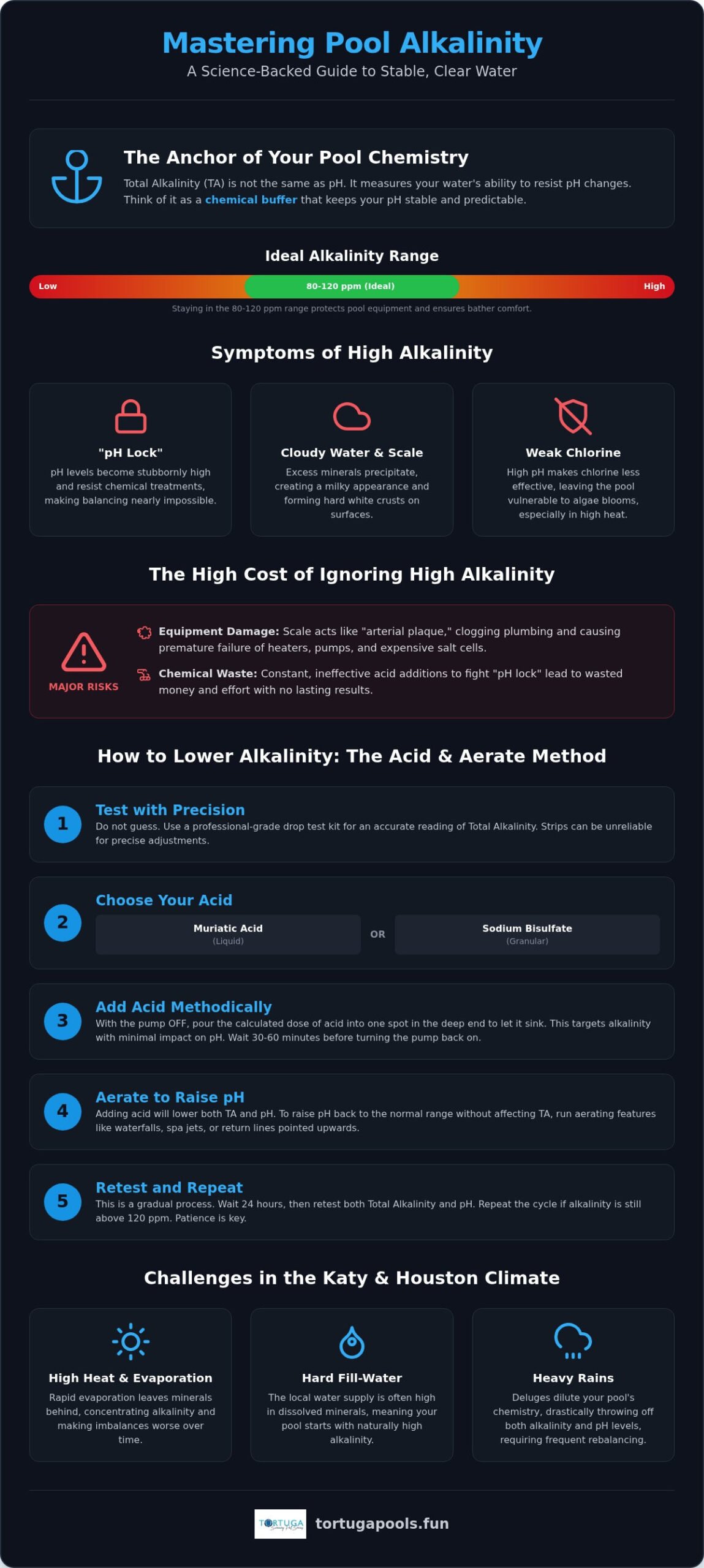
Total alkalinity is the foundation of pool chemistry, yet homeowners often confuse it with pH. Scientifically, Total Alkalinity is a measurement of the concentration of alkaline substances, such as bicarbonates, carbonates, and hydroxides, dissolved in your water. While pH measures how acidic or basic the water is at a specific moment, alkalinity measures the water’s capacity to neutralize acids and resist changes. Think of it as the anchor that keeps your water chemistry from drifting. For a healthy swimming environment, the ideal range is 80 to 120 parts per million (ppm). Staying within this window ensures bather comfort, prevents eye irritation, and protects your pool’s infrastructure from the corrosive effects of imbalanced water.
Why Alkalinity is the “Boss” of pH
Alkalinity acts as a buffer. When alkalinity is within the correct range, it absorbs the impact of external factors like heavy rain or high swimmer loads without allowing the pH to swing wildly. If your levels are too low, you’ll experience “pH bounce,” where the pH level shifts erratically with even minor chemical additions. Conversely, when levels are too high, the pH becomes locked in place. This is why mastering how to lower alkalinity in pool environments is a prerequisite for overall balance. You simply cannot stabilize your pH until you have addressed the underlying alkalinity issue through a disciplined, step-by-step process.
Alkalinity is the shock absorber for your water chemistry.
Signs Your Alkalinity is Too High
High alkalinity isn’t just a number on a test strip; it has visible, physical consequences for your pool and your wallet. If you’ve been adding acid to lower your pH only to find it back at a high level the next day, your alkalinity is likely the culprit. This resistance to change is the first red flag.
- Stubbornly high pH: The water resists chemical treatments, making it nearly impossible to maintain the Texas-required range of 7.2 to 7.8 for public pools, which is also the gold standard for residential safety.
- Cloudy water and scale: Excess minerals begin to fall out of suspension. This creates a milky appearance or hard white crusts on tiles, ladders, and internal plumbing.
- Reduced chlorine effectiveness: High alkalinity and high pH levels make your chlorine less active. This leaves your pool vulnerable to algae blooms, especially when Houston temperatures reach 90 degrees or higher.
Identifying these signs early allows you to take a methodical approach to correction before expensive equipment damage occurs. Understanding how to lower alkalinity in pool water is about more than just clarity; it’s about protecting the longevity of your home’s most valuable outdoor asset. Mastering this balance requires patience and precision, traits that define a well-maintained home.
The Risks of Ignoring High Alkalinity in Texas Pools
In the sweltering Houston summer, where June temperatures regularly reach 92°F and the heat index often exceeds 100°F, evaporation happens rapidly. As water leaves the pool through evaporation, it leaves behind dissolved minerals. This process concentrates alkalinity levels, turning a minor imbalance into a major maintenance hurdle. When alkalinity stays high, the water becomes saturated with minerals, leading to calcium carbonate precipitation. This isn’t just a cosmetic issue. It is a fundamental threat to your pool’s structural and mechanical integrity. Leaving these levels unchecked leads to massive chemical waste, as you’ll find yourself pouring acid into the water with no lasting result.
Scaling and Equipment Damage
High alkalinity is the primary driver of scale formation. This hard, crusty mineral deposit acts like “arterial plaque” for your pool’s plumbing. It restricts water flow in the pipes, forces your pump to work harder, and clogs the delicate pleats of your pool filter. The threat is especially severe for salt chlorine generators. Scale builds up on the internal plates of the salt cell, causing it to fail prematurely. These cells are expensive to replace; ignoring the balance results in avoidable financial loss. If you suspect your equipment has already suffered from mineral buildup, seeking professional pool repair near me is the most reliable way to diagnose the extent of the damage.
Water Clarity and Bather Comfort
Pool water is meant to be refreshing, not irritating. When alkalinity is high, bather comfort drops significantly. Swimmers often complain of “burning eyes” or itchy skin. While many blame chlorine for this discomfort, the true culprit is often the high pH that alkalinity locks in place. High alkalinity makes the water feel “hard” and abrasive against the skin. It also creates a persistent cloudiness that no amount of filtering can solve. Understanding the signs of unbalanced pool water helps you identify these issues before they ruin a weekend of swimming. Proper water chemistry is essential for maintaining pool water quality and ensuring the safety of your family.
This “chemical guessing game” is both expensive and exhausting. Learning how to lower alkalinity in pool water through a methodical process is the only way to break this cycle. For those who prefer a hands-off approach, our professional chemical balancing services ensure your water stays protective and pristine year-round. Taking action now prevents the need for more aggressive and costly repairs later in the season.
Choosing Your Tools: Muriatic Acid vs. Sodium Bisulfate
Selecting the right chemical is the first step in learning how to lower alkalinity in pool water safely. Most homeowners choose between liquid muriatic acid and dry sodium bisulfate. While both effectively reduce alkalinity, they carry different risks and benefits. Precision is key. You must prioritize safety by wearing chemical-resistant gloves and safety goggles every time you handle these substances. Always remember the foundational rule: add acid to water, never water to acid. This prevents dangerous splashing and potential chemical reactions. A disciplined approach to safety is just as important as the chemical dose itself.
Muriatic Acid: The Professional Choice
Professionals overwhelmingly prefer liquid muriatic acid for its speed and predictability. It is a powerful tool for rapid stabilization. To understand the chemistry better, you can read our guide on what muriatic acid does for pools. In the intense Texas heat, storage requires extra care. Muriatic acid fumes are highly corrosive. They can damage nearby metal equipment or even concrete floors if the container isn’t sealed perfectly. Store your acid in a cool, well-ventilated area, and never store it directly next to chlorine or other pool chemicals to prevent hazardous gas releases.
Sodium Bisulfate: The “Dry” Alternative
Sodium bisulfate, often sold as “dry acid” or “pH down,” is popular for its ease of handling. It is less intimidating for those wary of liquid splashes. However, it carries a hidden long-term cost. Frequent use leads to a buildup of sulfates in the water. High sulfate levels are aggressive toward natural stone finishes and can cause premature failure of salt chlorine generator cells. If your pool features high-end stonework or a salt system, we recommend avoiding dry acid in favor of liquid alternatives. Protecting your equipment from sulfate damage is a vital part of long-term maintenance. Salt system owners should also be aware that persistent high pH is one of the most damaging common salt water pool problems, accelerating scale buildup on the cell plates and reducing the system’s overall lifespan.
You may have heard of the “slug method,” where acid is poured into a single spot with the pump off. The theory suggests this targets alkalinity specifically. This is a myth. In reality, this creates a localized cloud of highly acidic water that can etch your pool’s plaster and damage the floor. A methodical craftsman knows that broadcasting the acid across the deep end with the pump running is the safer, more effective way to achieve a uniform balance. Consistency beats shortcuts every time. By distributing the chemical evenly, you ensure the entire volume of water is treated without risking the integrity of your pool’s surface.
The Methodical Step-by-Step Guide to Lowering Alkalinity
Lowering alkalinity is a titration process, not a one-time chemical addition. It requires patience and a disciplined cycle of testing, dosing, and aeration. If you attempt to rush this process, you risk crashing your pH to dangerous levels that can damage your pool’s surface and equipment. By following a steady sequence, you maintain control over the water’s stability and ensure the long-term health of your investment.
Step 1 & 2: Accuracy and Calculation
Precision starts with the right tools. Skip the unreliable test strips and use a high-quality liquid drop test kit. This ensures you aren’t chasing false readings, which is one of the most common pool chemical mistakes homeowners make. Once you have a verified reading, you must calculate your dose based on your pool’s exact volume. Guessing at your gallonage leads to over-treatment. A standard guideline is that it takes approximately 2.1 quarts of muriatic acid to lower alkalinity by 10 ppm in a 10,000-gallon pool. Always verify your math before you begin pouring.
Step 3: Add Acid. With the pump running, slowly pour the measured acid into the deepest part of the pool. This ensures the chemical is distributed evenly and doesn’t settle on the floor. Avoid the temptation to turn the pump off; circulation is your best defense against localized acidity that can etch plaster.
The Aeration Secret: Raising pH Without Alkalinity
This is the most critical step in learning how to lower alkalinity in pool water. Adding acid lowers both alkalinity and pH. To bring the pH back to the safe range of 7.2 to 7.8 without raising the alkalinity you just lowered, you must use aeration. Aeration introduces oxygen and encourages the “off-gassing” of carbon dioxide, which naturally raises pH levels. You can achieve this by turning on water features, engaging fountains, or simply pointing your return jets toward the surface to create bubbles. This physical process is the only way to raise pH without adding more alkaline substances.
Never use soda ash or baking soda to raise the pH during this specific cycle. These chemicals will immediately raise the alkalinity back up, undoing all your hard work. Retest your water after 24 to 48 hours of continuous aeration. If the alkalinity is still above your 80-120 ppm target, repeat the cycle. For homeowners who prefer a “steady hand” to manage these complex cycles, our professional chemical balancing services provide the meticulous care required for a perfectly balanced pool.
Managing Alkalinity in the Katy and Houston Climate
Maintaining a pool in Southeast Texas requires an understanding of our specific environmental pressures. In Katy and Fulshear, we don’t just deal with heat; we deal with water that is naturally mineral-heavy. During the peak of summer, when temperatures routinely hit 92°F, the rate of evaporation accelerates. This creates “evaporation creep.” As water evaporates, the alkaline substances remain behind, becoming more concentrated and driving your levels upward. This is often why homeowners who know how to lower alkalinity in pool water still find themselves struggling to maintain a steady balance during a Houston August. The minerals don’t leave; they only become more stubborn.
Fill Water Challenges in Southeast Texas
Your garden hose might be the primary source of your chemistry frustrations. Many local water districts, particularly within various Fort Bend MUDs, provide water with high calcium hardness and alkalinity. If you’re topping off your pool weekly to combat evaporation, you’re likely introducing water with an alkalinity level already exceeding 200 ppm. We recommend testing your tap water with the same precision you use for your pool. If the source water is high, you must adjust your chemical dosing immediately after a top-off to prevent the alkalinity from anchoring your pH too high. Heavy Texas rain can provide a brief reprieve since rainwater is naturally acidic, but it often introduces organic debris that consumes your chlorine. Relying on rain is not a strategy; consistent testing and verification are.
When to Call a Professional
There are times when a methodical DIY approach reaches its limit. If you’ve performed three consecutive acid-and-aerate cycles and your alkalinity still refuses to budge, there may be underlying issues with your water’s total dissolved solids (TDS) or cyanuric acid levels. Severe scaling on your tiles or inside your heater also indicates that the water has been imbalanced for too long. In these cases, an acid wash or professional equipment descaling may be necessary to restore your pool’s health. A weekly pool maintenance plan acts as the ultimate protective measure for your home. Having a “steady hand” to monitor these nuances ensures that your equipment remains efficient and your family stays safe. Professional stabilization removes the guesswork, allowing you to enjoy your pool rather than managing a chemistry lab every weekend.
Secure Your Pool’s Future with Stable Chemistry
Consistency is the hallmark of a well-maintained home. You now understand that alkalinity is the chemical anchor for your water; it’s the foundation that keeps your pH from drifting. Ignoring high levels leads to stubborn scale and avoidable equipment damage. By following a methodical acid-and-aerate cycle, you can reclaim control over your water and ensure a comfortable environment for your family. Mastering how to lower alkalinity in pool water is a vital skill for navigating the unique challenges of the Houston climate. It prevents the frustration of a chemical guessing game and protects your investment for the long term.
If you prefer a hands-off approach, we’re ready to step in with a steady hand. Get a Professional Chemical Balance from Tortuga Pools and benefit from our methodical chemical stabilization. As local Katy experts, we provide the trusted neighborly service you need to keep your sanctuary pristine. Your pool shouldn’t be a source of stress or a complicated chemistry project. With the right knowledge and a professional partner, you can enjoy crystal-clear water all year long.
Frequently Asked Questions
Can I swim immediately after adding muriatic acid to lower alkalinity?
You should wait at least 30 to 60 minutes before swimming after adding acid. Muriatic acid is highly concentrated and needs time to disperse throughout the water volume. Don’t enter too soon as it puts swimmers at risk of skin and eye irritation. Ensure your pump is running to facilitate circulation. For the safest results, retest your pH levels to confirm they’re within the Texas-recommended range of 7.2 to 7.8 before allowing anyone back into the water.
Is baking soda used to lower alkalinity in a pool?
Baking soda’s never used to lower alkalinity; it is actually the primary chemical used to raise it. To lower alkalinity, you must use an acid, such as liquid muriatic acid or dry sodium bisulfate. Using baking soda when your levels are already high will only worsen the problem, leading to scale buildup and cloudy water. Always verify your current levels with a professional drop test kit before adding any balancing chemicals to your pool water.
How long does it take for alkalinity to drop after adding acid?
The chemical reaction begins immediately, but you must wait at least 24 hours before retesting. This window allows the acid to circulate fully and the water chemistry to stabilize. If you’re also using aeration to raise the pH, this 24-hour period’s essential for seeing the true results of your efforts. Rushing the testing process often leads to inaccurate readings and the risk of over-treating your pool with unnecessary chemicals that could damage the finish.
Why does my pool alkalinity keep going up every week?
In the Katy and Houston area, high alkalinity’s often caused by our local fill water. As water evaporates in the 90-degree Texas heat, the minerals remain behind and become more concentrated. When you top off the pool with fresh tap water, you’re adding more alkaline substances. Understanding how to lower alkalinity in pool is essential to combat this evaporation creep. Regular chemical balancing is the only way to stay ahead of these local environmental pressures.
Can high alkalinity cause green pool water?
High alkalinity doesn’t directly turn water green, but it creates the perfect environment for algae to thrive. It locks your pH at a high level, which significantly reduces the sanitizing power of chlorine. When chlorine doesn’t work at peak efficiency, algae can take hold quickly, especially during humid Houston summers. Knowing how to lower alkalinity in pool environments ensures your chlorine can effectively keep the water clear and safe for your family to enjoy all season long.
What happens if I lower my alkalinity too much?
Lowering alkalinity below 80 ppm makes your water chemistry unstable and corrosive. You’ll experience “pH bounce,” where the pH level swings wildly with the slightest addition of chemicals or even a heavy rainstorm. Low alkalinity also makes the water aggressive, which can etch pool plaster and cause metal components in your heater to degrade prematurely. Maintaining the 80 to 120 ppm range is a disciplined requirement for protecting your pool’s long-term structural and mechanical health.
Does shocking a pool lower the alkalinity level?
No, shocking your pool doesn’t lower alkalinity. Most common shocks, such as Calcium Hypochlorite or liquid chlorine, have a high pH and may actually cause a slight increase in alkalinity over time. Shocking is designed to kill bacteria and algae, not to balance the water’s mineral content. If you need to address high alkalinity, you must follow the methodical acid-and-aerate process described in this guide rather than relying on standard sanitation treatments or quick fixes.
Is the “Slug Method” better than broadcasting acid?
The “Slug Method” is a persistent myth that can cause significant damage to your pool. Poured in one spot, the acid sinks to the bottom and can etch your plaster or damage the floor. Broadcasting the acid across the deep end with the pump running is the professional standard. This ensures the chemical is distributed evenly throughout the water. A methodical craftsman prioritizes the safety of the pool surface over unproven shortcuts that offer no real chemical advantage.