
Your pool water might look crystal clear even while it’s actively corroding your heater or irritating your children’s skin. Chemical balance is an invisible foundation; by the time you notice physical changes, the water has likely been “attacking” your pool’s surfaces and internal components for weeks. Identifying the early signs of unbalanced pool water is the only way to prevent a minor chemistry shift from becoming a thousand-dollar equipment repair. It’s about precision over guesswork.
We understand the frustration of second-guessing test strips and the anxiety that comes with wondering if your family is swimming in safe conditions. You deserve a predictable maintenance routine that protects your investment rather than threatening it. This guide provides a disciplined look at the red flags often overlooked by the untrained eye. We’ll walk through the specific mechanical and physical indicators of imbalance, from white scale buildup to subtle pump issues, so you can maintain a healthy, stable environment for your home in Katy or Fulshear. You’ll learn to spot the technical warnings before they require professional intervention.
Key Takeaways
- Understand that visual clarity is not a guarantee of safety; learn why clear water can still be chemically aggressive and corrosive to your pool’s surfaces.
- Identify the physical signs of unbalanced pool water, such as skin irritation or white scale buildup, before they escalate into structural damage.
- Protect your investment by understanding how chemical imbalances silently attack expensive heaters and pumps from the inside out.
- Discover why professional-grade testing is essential in the Katy climate, where 100-degree days rapidly shift chemical levels beyond what basic test strips can measure.
- Establish a disciplined maintenance routine that replaces reactive repairs with methodical, long-term stability for your home and family.
Understanding the Invisible Foundation of Balanced Pool Water
Clear water is often a mask. Many homeowners assume that if they can see the bottom of the deep end, the chemistry is perfect. This is a dangerous misconception. Balanced water is a precise state of equilibrium where the water is neither corrosive nor scale-forming. When this balance shifts, the signs of unbalanced pool water may not appear until physical damage has already occurred. For a deeper look at the technical requirements of this balance, you can consult this comprehensive guide to pool sanitation. In the Katy and Fulshear area, the relentless Texas sun adds a layer of complexity. We treat Cyanuric Acid as a “sunscreen” for your chlorine. Without it, UV rays strip your sanitizer in hours. This leaves the water vulnerable to pathogens even if it looks inviting. High evaporation rates in Houston also mean these chemical levels can concentrate quickly, making precision testing a necessity.
The Four Pillars of Pool Chemistry
Maintaining stability requires a methodical approach to four key metrics. We don’t rely on gut feelings; we rely on verified measurements to ensure your pool remains a safe environment.
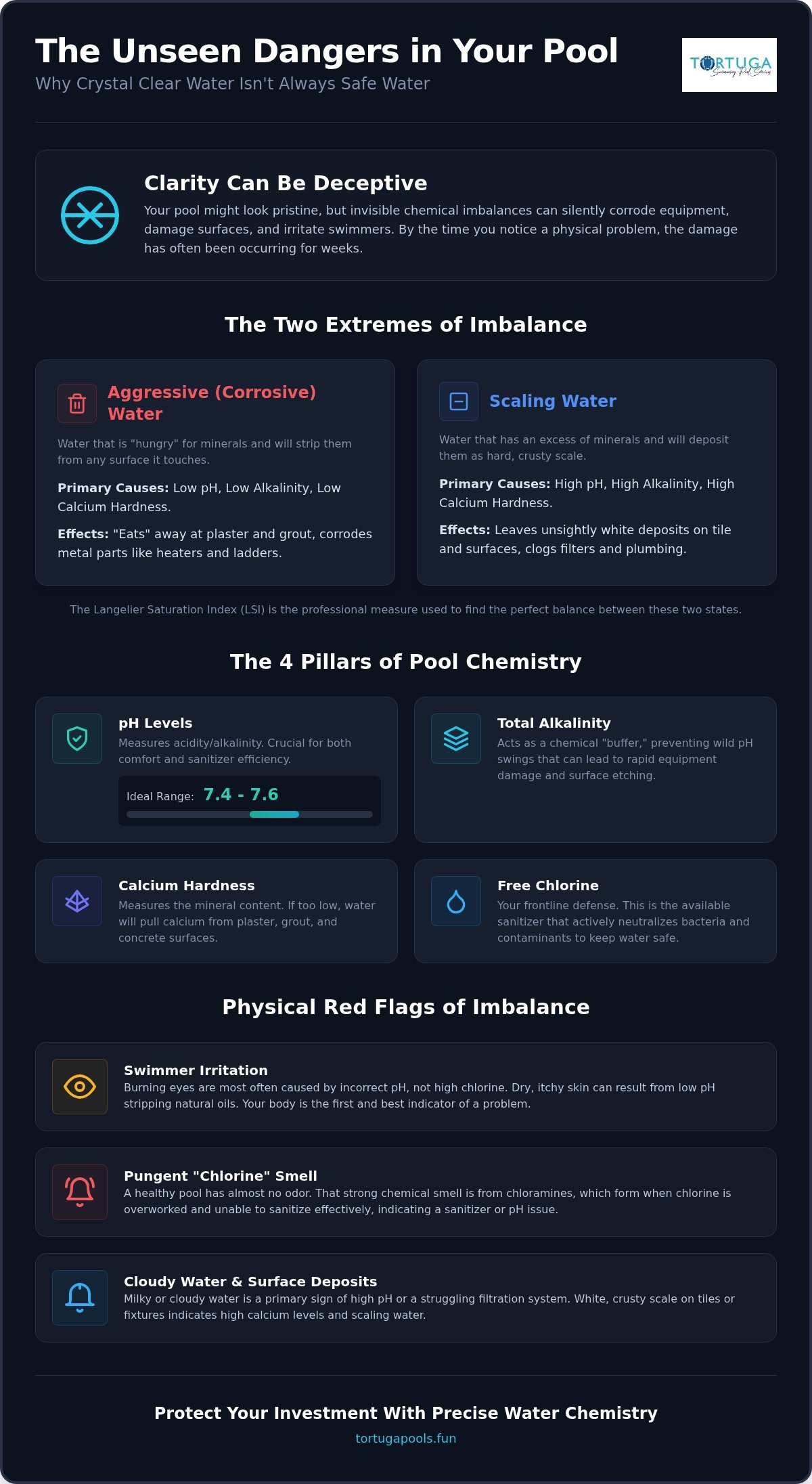
- pH levels: Maintaining a range of 7.4 to 7.6 is essential. This “sweet spot” matches the pH of human eyes and skin, ensuring swimmer comfort while allowing chlorine to work effectively.
- Total Alkalinity: This acts as a chemical buffer. It prevents erratic pH swings that can lead to rapid equipment deterioration and plaster etching. When alkalinity climbs too high, it locks your pH in an unhealthy range — learning how to lower alkalinity in pool water with a disciplined acid-and-aerate cycle is an essential skill for restoring balance.
- Calcium Hardness: Water is naturally “hungry” for minerals. If your calcium levels are too low, the water will pull what it needs from your plaster or grout.
- Free Chlorine: This is your frontline defense. It sanitizes the water by neutralizing bacteria and organic matter.
These four pillars must work in harmony; a failure in one area inevitably compromises the others, leading to a cascade of maintenance issues.
Aggressive vs. Scaling Water
Water that lacks proper balance generally falls into two categories. Aggressive water occurs when pH and calcium levels are too low. It essentially “eats” your pool’s surfaces and copper heater components. On the opposite end, scaling water happens when these levels are too high. This results in unsightly white deposits on tile lines and restricted flow in your plumbing. Identifying the early signs of unbalanced pool water helps you avoid these extremes before they require expensive resurfacing. When pH climbs too high, understanding what does muriatic acid do for pools becomes essential knowledge for restoring balance and protecting your surfaces. The Langelier Saturation Index (LSI) is the industry standard for measuring water saturation to determine if your pool is in a balanced, corrosive, or scaling state.
The 5 Physical Red Flags of Chemical Imbalance
A methodical inspection starts with your senses. You don’t need a lab kit to notice the first signs of unbalanced pool water; you simply need to know what to look for during your weekly walk-around. Professional maintenance relies on these visual and physical cues to identify trends before they become failures. While clear water is the goal, it can hide aggressive chemistry that irritates the body and degrades surfaces. Following established pool water chemistry guidelines helps you understand that what you feel in the water is often the most accurate biological indicator of a chemical shift. Observation is the first step in a protective maintenance routine.
Swimmer Irritation: Eyes, Skin, and Lungs
The common “chlorine smell” is actually a myth. A healthy pool should have almost no scent. That pungent odor comes from chloramines, which form when chlorine is overworked and unable to fully oxidize organic matter. This usually points to a sanitizer deficiency or a significant pH imbalance. Burning eyes are another frequent complaint. While many blame high chlorine, the culprit is typically a pH level that has drifted too far from the human eye’s natural 7.4. When the water becomes too acidic or too alkaline, it creates immediate discomfort. Dry, itchy skin often follows. High alkalinity or low pH strips the natural oils from your skin, leaving a tight, uncomfortable sensation after a swim. These are clear signals that your chemical balancing needs adjustment to restore a protective environment for your family.
Visual Water Quality and Surface Deposits
Cloudy or milky water is a primary indicator of distress. It suggests that your pH is too high or your filtration system is struggling to keep up with the local Katy heat. If the water looks dull, the sanitizer efficiency has likely dropped. You may also notice “sandpaper” walls. This rough texture is calcium scale precipitating out of the water and bonding to your plaster. It’s a direct result of high pH and high calcium hardness. If you see white flakes on the tile line or floating in the water, the saturation index is out of range — high total alkalinity is often the stubborn anchor keeping your pH locked in a scaling range, and a methodical approach to how to lower alkalinity in pool water can stop these deposits before they cause permanent surface damage. Algae blooms are the final, most visible red flag. Once you see green or yellow growth, the chemistry has already failed. For those dealing with a sudden takeover, our green pool algae cleanup Katy guide provides the necessary recovery steps. Consistent observation prevents these physical symptoms from turning into permanent surface damage.
Hidden Damage: How Unbalanced Water Attacks Your Equipment
The most catastrophic signs of unbalanced pool water aren’t always visible on the surface. They occur inside the dark, metallic components of your filtration and heating systems. Aggressive water acts as a slow-moving solvent, stripping minerals and metals from your equipment to satisfy its chemical hunger. Replacing a high-efficiency heater or a variable-speed pump is a major expense that can often be avoided. A disciplined weekly balancing routine is a protective measure for your home’s infrastructure. If you ignore the chemistry, you’re essentially allowing your water to “eat” your investment from the inside out.
Corrosion: The Silent Equipment Killer
Low pH is the primary driver of mechanical destruction. When water becomes acidic, it targets the copper heat exchanger inside your heater. You might notice teal or blue-green stains on your pool floor. This is a clear indicator that your heater’s internal copper is dissolving and precipitating back into the pool. It’s a technical red flag that the equipment is failing. Acidic water also attacks the rubber components throughout your system. Pump seals, O-rings, and gaskets become brittle and lose their elasticity, leading to leaks that are difficult to track. If you hear a grinding noise or see water dripping from the motor housing, you may need pool pump repair Katy TX to address the damage caused by chemical etching. Correcting low pH with a precision tool like muriatic acid — and understanding what does muriatic acid do for pools in terms of controlled pH reduction — is a critical skill for preventing this kind of equipment damage.
Scaling and Clogging Internal Systems
On the opposite end of the spectrum, high pH and excessive calcium hardness lead to internal clogging. In salt-water pools, the electrolytic cell is the first component to suffer. Calcium scale builds up on the plates, forcing the system to work harder while producing less chlorine. This creates a cycle where the pool becomes increasingly difficult to manage. Inside your plumbing, scale acts like plaque in an artery. It narrows the diameter of the pipes, which increases backpressure and forces your pump motor to run at higher temperatures. Over time, this extra strain leads to premature motor failure. Even your filter media is at risk. Calcification can turn loose sand or pleated cartridges into a solid, stone-like block that no longer captures debris. Methodical testing and verification are the only ways to prevent these invisible attacks on your equipment.
The Methodical Testing Protocol: DIY vs. Professional Service
Testing is the only way to verify that your water is safe. In the Katy area, where summer temperatures frequently stay above 100 degrees, the chemical demand on your pool is relentless. A monthly check is simply insufficient for the Texas climate. By the time the physical signs of unbalanced pool water become obvious, your equipment has likely been under stress for weeks. True stability requires a professional pool water testing service that prioritizes accuracy over convenience. We treat every test as a technical inspection. Nothing is left to guesswork.
The Limitations of Home Test Strips
Home test strips offer a quick glance, but they lack the precision required for long-term maintenance. The process of color matching is inherently subjective. A subtle shift in a shade of pink or green can represent a significant chemical imbalance that strips cannot pinpoint. Storage environment also matters. Storing test kits in a humid garage ruins the chemical reagents. This leads to false readings and improper dosing. These kits often fail to provide the granular data needed to manage Total Alkalinity or Cyanuric Acid. These are the anchors of your pool’s chemistry. Accuracy is non-negotiable.
Professional Balancing in Katy and Fulshear
Our team utilizes a methodical 7-point testing protocol to ensure every variable is accounted for. This isn’t just about adding chlorine. We analyze how local evaporation rates concentrate minerals and chemicals in your water. When water levels drop during a Houston heatwave, the remaining chemicals become more potent. This can lead to scaling or equipment etching if not managed with precision. Our approach is built on neighborly accountability. We treat your property with the same diligence we apply to our own. This methodical verification process ensures that every adjustment is based on data, not a “gut feeling.” We believe in stability through consistency. For a comprehensive solution, our weekly pool maintenance Katy TX plan offers the consistent oversight needed for a healthy pool. Contact us for a professional chemical balancing assessment and experience the difference that methodical care makes for your home.
Professional Water Balancing: The Tortuga Pools Approach
At Tortuga Pools, we view water chemistry as a discipline of prevention rather than a series of emergencies. Most homeowners only seek professional help when the signs of unbalanced pool water are impossible to ignore. Our approach is designed to ensure you never reach that point. We move away from the reactive “fix it” mentality and focus on maintaining a consistent, stable environment. This shift in perspective transforms your pool from a source of anxiety into a reliable sanctuary for your family. We operate with a sense of neighborly accountability, treating every property with the same diligence we apply to our own.
Precision Chemical Stabilization
We utilize the Langelier Saturation Index (LSI) on every single visit to verify that your water is perfectly balanced. This isn’t a one-time calculation; it’s a dynamic measurement that accounts for temperature shifts and water levels in the Katy heat. We avoid the common mistake of “chemical dumping,” where large quantities of acid or shock are used to force a rapid result. Instead, we use a “steady hand” approach. Small, precise adjustments allow the water to reach equilibrium without the stress of erratic chemical swings. We rely on professional-grade reagents that provide a level of accuracy far beyond retail kits. This methodical process ensures that your pool water remains protective of your plaster and equipment foundations.
Protecting Your Family and Your Home
Safety is our primary objective. As a family-owned business, we understand that your pool is a place for children and pets. Ensuring the water is safe and non-irritating every week is a responsibility we take seriously. We aren’t just cleaning surfaces; we are managing a complex ecosystem. By maintaining this stability, we effectively extend the life of your pool’s plaster finish and internal mechanical components. Consistent care is the most effective way to protect your home investment from the corrosive effects of chemical neglect. We believe in a step-by-step philosophy that prioritizes long-term health over quick, superficial fixes.
We bridge the gap between technical science and your peace of mind. You don’t need to be a water chemist to enjoy a perfect pool; you simply need a partner who values quality and patience over speed. We invite you to request a methodical water assessment to see how a disciplined routine can stabilize your pool for the long term. Let us provide the steady hand your pool needs to remain a safe, beautiful asset for your home.
Securing Your Pool’s Future Through Methodical Care
Maintaining a healthy pool in the Texas heat requires more than occasional skimming and guessing. It’s about recognizing that the early signs of unbalanced pool water are often invisible to the untrained eye. By the time you notice surface scaling or equipment failure, the water has likely been attacking your investment for weeks. True stability comes from a disciplined routine that prioritizes measurement over estimation.
As a locally owned business in Katy, we specialize in precise chemical stabilization designed for our specific climate. We utilize a methodical 7-point water testing protocol to ensure every variable is verified. This steady hand approach protects your family’s safety and extends the lifespan of your pool equipment. You don’t have to manage this complex chemistry alone. Request a Methodical Water Assessment from Tortuga Pools today. Let’s establish a protective maintenance plan that gives you total peace of mind. Your pool should be a source of relaxation; we’re here to keep it that way.
Frequently Asked Questions
How can I tell if my pool water is unbalanced without a test kit?
You can identify the signs of unbalanced pool water through physical and visual indicators. Look for cloudy or dull water, white flakes on the tile line, or a rough sandpaper texture on the plaster. Biological signs include stinging eyes or itchy skin after swimming. While these cues signal a problem, they often appear only after damage has begun. Verification with a professional test remains the only way to determine exact chemical needs.
Is it safe to swim in a pool with unbalanced pH?
Swimming in water with a pH outside the 7.2 to 7.8 range is generally discouraged. When pH is too low, the water becomes acidic, causing significant eye and skin irritation. If the pH is too high, chlorine loses its ability to sanitize effectively, potentially exposing swimmers to bacteria. Maintaining a stable pH is a protective measure for your family’s health and ensures your sanitizer works as intended.
Why does my pool water smell like chlorine if the levels are low?
That strong pool smell is caused by chloramines, which form when chlorine reacts with organic contaminants like sweat or oils. This odor actually indicates that your free chlorine is depleted and unable to finish the oxidation process. It is a technical sign that your water needs a methodical adjustment to restore balance. A healthy, properly balanced pool should have almost no detectable chemical scent during normal operation.
How often should I have a professional pool water testing service visit?
We recommend a professional pool water testing service visit at least once per week. In the Katy and Fulshear area, the extreme summer heat and high evaporation rates can shift chemical levels in a matter of days. Weekly oversight allows for small, steady adjustments that prevent the yo-yo effect of drastic chemical dosing. This consistency is the foundation of equipment longevity and consistent water safety.
Can unbalanced water cause permanent damage to my pool plaster?
Yes, corrosive water with low calcium hardness or low pH will permanently etch and pit your plaster. The water essentially eats the minerals out of the surface to balance itself. Conversely, high pH and calcium lead to scale deposits that are difficult and expensive to remove. Identifying the signs of unbalanced pool water early is the only way to prevent these structural issues from requiring a full resurfacing.
What happens if I ignore high calcium hardness in my Katy pool?
Ignoring high calcium hardness leads to significant scale buildup inside your plumbing and on your pool surfaces. In the Katy area, our source water is often mineral-rich, which compounds the problem. Over time, this scale restricts water flow, puts excessive strain on your pump motor, and can ruin salt-water chlorine generator cells. Methodical monitoring prevents these minerals from precipitating out of the water and damaging your home investment.
Does rain affect the chemical balance of my pool in Fulshear?
Heavy rain in Fulshear and Houston significantly impacts your pool’s equilibrium. Rainwater is typically acidic, which lowers your pH and total alkalinity. Additionally, storm runoff introduces organic debris and nitrates that consume your chlorine at an accelerated rate. After a major rain event, we prioritize a thorough re-testing of all seven chemical pillars to ensure the water hasn’t become aggressive or prone to algae growth.
How long after adding chemicals can I safely swim?
Most chemicals require at least one full turnover of the pool water, usually taking 15 to 60 minutes, before it’s safe to swim. For pH adjusters or alkalinity boosters, waiting 30 minutes with the pump running is a standard precaution. However, if you’ve added a concentrated shock treatment, you must wait until chlorine levels drop back into the safe 2.0 to 4.0 ppm range. Always verify levels with a test.