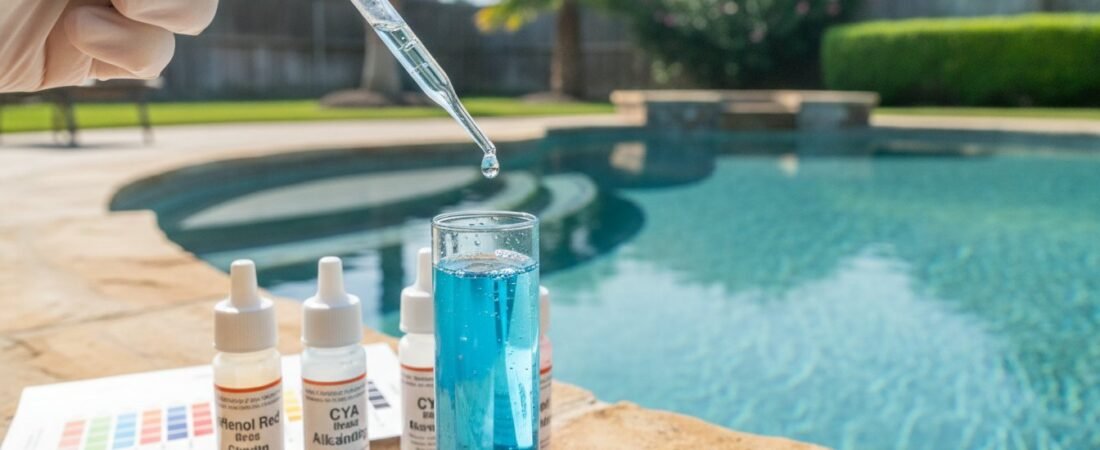
Most pool owners believe that as long as the water looks clear, the chemistry is correct, but that assumption is often what leads to the most expensive equipment failures. It’s a harsh reality that “close enough” is rarely sufficient when managing thousands of gallons. You likely know the frustration of spending a weekend buying treatments only to end up with red eyes and a heater that sounds like it’s struggling. It’s exhausting to waste money on chemicals that don’t work while worrying about your pumps. Identifying common pool chemical mistakes is the first step toward moving away from reactive fixes. Precision over guesswork. Stability over speed.
We understand that your pool is a vital investment for your home in Katy, Fulshear, or Houston. This guide helps you discover the frequent errors that damage expensive equipment and teaches you how a disciplined, professional balancing routine protects your family. You’ll learn how to achieve crystal clear water year-round and lower your long-term repair costs. We will examine the specific imbalances that lead to corrosion and the precise testing methods that keep your water safe and stable.
Key Takeaways
- Learn why standard test strips often fail to provide the precision needed to protect your pool’s surfaces and internal components.
- Identify the common pool chemical mistakes that lead to costly equipment corrosion and plumbing scale, saving you from premature heater and pump failures.
- Understand how the extreme Houston heat and sudden Texas thunderstorms rapidly deplete chlorine and destabilize your water’s pH levels.
- Discover the “precision gap” between consumer-grade testing and professional titration to determine if DIY maintenance is actually costing you more in the long run.
- Explore a methodical “steady hand” approach to chemical dosing that prioritizes small, accurate adjustments over aggressive chemical dumps.
The Science of Balance: Why DIY Chemical Testing Often Fails
Chemical balancing is far more than a simple addition of chlorine to keep the water clear. It is a delicate equilibrium between effective sanitation, bather comfort, and the long-term protection of your pool’s physical surfaces. The Science of Pool Sanitation demonstrates that these variables are deeply interconnected. When one factor shifts, the entire system reacts. Many homeowners fall into a cycle of reactive maintenance, which is where common pool chemical mistakes begin to compromise the integrity of the pool.
The true measure of water health isn’t found on a basic color chart but through the Langelier Saturation Index (LSI). This index calculates whether your water is corrosive, scale-forming, or perfectly balanced based on pH, temperature, and calcium hardness. Without this methodical calculation, you’re essentially guessing. In the intense heat of Katy and Fulshear, liquid reagents also have a limited shelf life. Standard Texas summers can ruin these chemicals in a matter of weeks if they aren’t stored in a climate-controlled environment. Using degraded reagents leads to flawed data and incorrect dosing.
The Limitations of Residential Test Kits
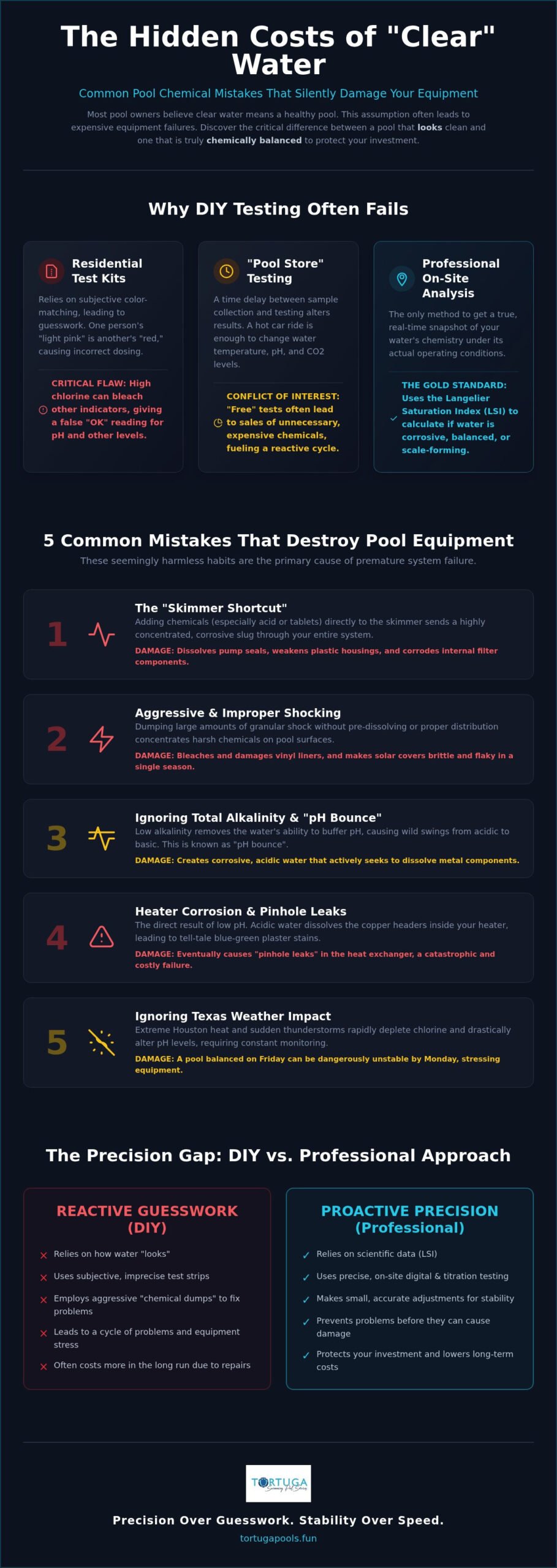
Most residential kits rely on color-matching, which is inherently subjective. One person’s interpretation of a shade of red can differ significantly from another’s, leading to frequent over-dosing of acid or soda ash. Also, high chlorine levels can actually bleach the indicators for other tests. This creates a false reading that suggests your pH is fine when it might be dangerously low. Reagent interference is a primary cause of DIY balancing errors.
The Problem with the “Pool Store Test” Strategy
Relying on a retail store for testing introduces a critical time delay. As soon as you pull a water sample and place it in a hot car, the chemistry begins to shift. By the time the sample reaches the store, the temperature change has already altered the pH and CO2 levels. This reactive cycle is one of the most common pool chemical mistakes we see in the Houston area. There is also a clear conflict of interest in this model. Retailers often provide “free” tests as a gateway to sell a basket of expensive chemicals. Professional on-site testing remains the only way to capture a real-time snapshot of your water’s health under actual operating conditions.
5 Common Pool Chemical Mistakes That Damage Your Equipment
Maintaining a pool in the Katy and Houston climate requires a steady hand and a disciplined eye. Many homeowners unintentionally accelerate the wear on their systems by making common pool chemical mistakes that seem harmless at first. It’s a common misconception that chemicals only affect water clarity; in reality, they are the primary factor in the lifespan of your mechanical hardware. Poor chemistry doesn’t just make the water uncomfortable, it actively destroys your investment from the inside out. Following the Safe Handling of Pool Chemicals is the first step toward a safer environment, but mechanical preservation requires deeper technical precision.
One of the most destructive habits is adding chemicals, especially chlorine tablets or muriatic acid, directly into the skimmer basket. This sends a concentrated “slug” of highly corrosive liquid directly through your pump, seals, and filter. Over time, this practice dissolves rubber gaskets and weakens plastic housings. Similarly, improper shocking routines can be disastrous. Damping a large amount of granular shock into a pool without proper distribution can bleach vinyl liners or cause solar covers to become brittle and flake apart within a single season.
Corrosive Water and Heater Failure
When total alkalinity is low, your water lose its ability to resist pH changes. This creates a “pH bounce” where levels swing wildly from one extreme to another. Acidic water acts as a solvent, specifically targeting the copper headers inside your heater. As the copper dissolves, it enters the water stream, often staining your pool’s plaster a telltale blue-green color. Eventually, this erosion leads to the “pinhole leak” phenomenon in heat exchangers, which renders the unit useless. A costly pool heater repair is often the direct result of months of neglected alkalinity and pH levels. Acid eats metal. It is that simple.
Calcium Hardness: The Silent Plumbing Killer
In our local area, the ideal range for calcium hardness typically sits between 200 and 400 ppm. When levels exceed this, the water becomes “oversaturated” and begins to deposit calcium as scale on every surface it touches. This scaling isn’t just an eyesore on your tile line; it builds up inside your internal plumbing and salt cells. This restriction reduces the efficiency of your pump, forcing it to work harder and increasing your monthly energy bills. If you notice a decrease in water flow or a high-pitched whine from your motor, check your chemistry first. Recognizing the signs of unbalanced pool water early — from white scale buildup on your tile line to subtle changes in pump performance — can prevent long-term calcium mismanagement from becoming a costly repair. Some signs of a failing pool pump are actually symptoms of long-term calcium mismanagement. Before assuming your pump needs full replacement, it’s worth understanding the pool pump repair cost factors that determine whether a targeted fix or an upgrade is the smarter investment. A methodical weekly service from Tortuga Pools ensures these technical details are never left to chance, protecting your home and family through consistent care.
DIY vs. Professional Balancing: The Precision Gap
The decision to manage your own water chemistry often stems from a desire to save on monthly costs. However, the real divide between a homeowner and a specialist is the precision gap. While a DIY approach usually relies on a quick dip of a test strip, a professional uses volumetric titration to achieve a molecular-level understanding of the water. This distinction is vital. Many common pool chemical mistakes occur because consumer-grade tools are inherently subjective. A strip that looks “close enough” to a target shade can actually represent a massive over-correction in a 25,000-gallon system. Precision isn’t just about clarity; it is about the stability of your entire aquatic environment.
Beyond accuracy, there is the significant factor of safety and liability. Handling concentrated muriatic acid and high-strength chlorine requires specific protocols and protective gear. An expert understands the volatile nature of these substances and ensures they are stored and applied without risk to your family or property. To fully understand what muriatic acid does for pools and how it functions as a precision tool for lowering pH and alkalinity, homeowners benefit greatly from professional guidance rather than trial and error. This methodical oversight provides a protective measure that a “bucket and a guess” simply cannot match. Professional care serves as a preventative shield, helping you avoid a costly green pool algae cleanup by catching microscopic imbalances before they bloom.
Accuracy and Measurement Tools
Professional technicians don’t “eye-ball” a liquid pour. We use precise volumetric measurements to ensure every ounce of chemical serves a specific purpose. This process includes monitoring Total Dissolved Solids (TDS), a metric that DIYers often ignore. When TDS levels become too high, your chemicals lose their effectiveness, regardless of how much you add. By calculating the exact saturation point of the water, a specialist ensures the chemistry is neither corrosive nor scale-forming. It is a data-driven process that eliminates the guesswork of residential kits.
The Hidden Costs of DIY Maintenance
Wasted chemicals from over-correcting errors are a significant hidden expense. When a homeowner misreads a test and adds too much acid, they must then buy more soda ash to fix the mistake. This “chemical see-saw” is expensive and hard on your equipment. There is also the “lost weekend” cost for homeowners in Katy and Fulshear. Spending hours at a retail store and laboring over a pool takes time away from your family. Investing in professional weekly pool maintenance doesn’t just save time; it extends the life of your pool finish and mechanical systems through consistent, disciplined care.
A Methodical Approach to Seasonal Chemical Adjustments in Katy
The environment in Katy and Houston presents unique challenges that standardized pool manuals often overlook. In this region, environmental factors like extreme UV exposure and sudden tropical downpours are the primary drivers of chemical instability. One of the most common pool chemical mistakes is failing to adjust your maintenance routine as the Texas seasons shift. A “set it and forget it” mentality leads to rapid water degradation, especially during the summer peak when the sun acts as a catalyst for chemical depletion. Precision is required to stay ahead of these environmental shifts.
UV burn-off is a relentless force. On a typical 100-degree Houston day, unprotected chlorine can be depleted by up to 90% in just two hours. This is why a methodical approach to stabilizer levels is essential. Before the heatwave hits, you should verify your Cyanuric Acid (CYA) levels. Ideally, these should stay between 30 and 50 ppm. If they fall too low, your chlorine vanishes. If they climb too high, usually from over-using stabilized tablets, you enter “Chlorine Lock” where the sanitizer is present but chemically unable to work. Balancing this requires a steady hand and consistent testing.
Managing the Texas Summer Heat
Think of Cyanuric Acid as sunscreen for your chlorine. It shields the molecules from UV degradation, allowing them to stay in the water longer to kill bacteria. However, discipline is required. When stabilizer levels exceed 100 ppm, the only resolution is often a partial drain and refill of the pool. To combat the heat, we also recommend increasing your pump’s circulation time. Moving water is harder to stagnate and helps distribute chemicals more effectively during peak sun hours when the demand is highest.
Post-Storm Recovery Protocols
Texas thunderstorms do more than just add water to your pool. Rain is typically acidic and lacks minerals, which means a heavy Katy downpour can instantly crash your pH and Total Alkalinity. Storms also introduce organic debris like leaves, dirt, and pollen. This debris brings phosphates into the water, which serve as an all-you-can-eat buffet for algae. Neglecting the pool after a storm is one of the common pool chemical mistakes that leads to an overnight bloom.
Immediate action is required after a storm. Skim the debris, check the filter pressure, and re-test the chemistry within 24 hours. If the water begins to haze, it’s a sign that the sanitation has failed. If balance isn’t restored quickly, you may need a professional green pool algae cleanup to kill the spores before they take over. Even in the winter, maintenance remains a protective measure for your home. While you might not be swimming, the water still needs to be balanced to prevent equipment corrosion and staining. A disciplined seasonal pool opening service in the spring ensures that months of winter dormancy haven’t left your equipment vulnerable to chemical imbalances that compound once the Texas heat arrives. For a reliable, year-round maintenance plan that adapts to the Fulshear and Katy climate, contact the experts at Tortuga Pools for a methodical service assessment.
Professional Pool Chemical Balancing: The Tortuga Pools Standard
At Tortuga Pools, we view water chemistry as a protective measure for your home and family. Our “Steady Hand” philosophy is the intentional alternative to the aggressive chemical dumps often seen in DIY maintenance. We prioritize small, verified adjustments that maintain a stable environment rather than chasing numbers with massive doses. This disciplined approach prevents the common pool chemical mistakes that lead to equipment degradation and water instability. Precision is our baseline. Guesswork is our enemy.
Maintaining a pool in Katy, Fulshear, or Houston requires a technician who understands the local environmental stressors. We don’t just add chlorine; we manage an ecosystem. By adhering to a rigorous, step-by-step verification process, we ensure that every chemical addition is calculated based on the specific volume and current state of your water. This methodical oversight provides a level of consistency that protects your investment and ensures your water is always ready for your family to enjoy.
Our Methodical Weekly Routine
Every visit begins with a comprehensive 7-point water test. We measure free chlorine, total chlorine, pH, total alkalinity, calcium hardness, cyanuric acid, and phosphates. This data-driven snapshot allows us to make precise corrections before they become visible problems. Alongside the chemistry, we perform a professional inspection of your equipment health. We monitor the performance of your pumps and heaters to ensure that chemical levels aren’t causing internal wear. Our commitment to safety extends to your entire property, ensuring that all chemicals are handled and stored with the utmost care for your children and pets.
Why Katy Neighbors Trust Tortuga Pools
As a local, family-owned business, we operate with a sense of neighborly accountability. We provide professional documentation and testing logs for every visit, giving you a transparent history of your pool’s health. This consistency leads to significant long-term savings by extending the life of your plaster and mechanical systems. You don’t have to spend your Saturdays at a retail store or laboring over a test kit. Reclaim your time and enjoy the peace of mind that comes from expert-led care. Schedule your professional chemical balancing service today and experience the “steady hand” difference that keeps your water safe and clear year-round.
Protect Your Investment with Disciplined Water Care
Maintaining a pool in the Katy area requires more than a casual glance at a test strip. True water health is found in the balance between effective sanitation and mechanical preservation. By understanding the science behind your water chemistry, you move from reactive fixes to a protective maintenance routine. Avoiding common pool chemical mistakes, such as ignoring saturation levels or over-stabilizing your water, ensures that your pumps, heaters, and plaster surfaces remain in peak condition for years to come. Consistency is the foundation of a safe, clear, and efficient swimming environment.
Tortuga Pools is here to provide the “steady hand” your property deserves. As a local, family-owned and operated business, we treat your investment with the same care we give our own. Our service includes a methodical 7-point water testing process and an expert equipment diagnosis at every visit to catch small issues before they become expensive repairs. Let us handle the technical details so you can simply enjoy your backyard. Get a Professional Chemical Balancing Quote for Your Katy Pool and reclaim your weekends with confidence. Your family’s comfort and your home’s value are worth the precision of professional care.
Frequently Asked Questions
How often should I test my pool chemicals in the Houston summer?
You should test your water at least two to three times per week during the peak Houston summer. The extreme UV index and consistent 100-degree temperatures can deplete your sanitizer in a matter of hours. A methodical testing schedule allows you to identify these shifts early. It’s the only way to ensure your water remains safe for your family while protecting your expensive pump and heater components from fluctuating chemical levels.
Why is my pool water cloudy even though chlorine levels are high?
Cloudy water often points to a filtration issue or a high concentration of Total Dissolved Solids (TDS). Even with high chlorine, your water won’t stay clear if your pH is mismanaged or your stabilizer levels have reached “chlorine lock.” This is among the most common pool chemical mistakes we see in Katy. It requires a disciplined look at the entire Langelier Saturation Index rather than just adding more sanitizer to the system.
Is it safe to swim immediately after adding muriatic acid to the pool?
It’s best to wait at least 30 to 60 minutes after adding muriatic acid before entering the water. Ensure your pump is running at a high speed to facilitate proper circulation. Because acid is denser than water, it can settle in concentrated pockets at the bottom of the pool. Waiting for full integration prevents skin irritation and ensures the chemical has been safely distributed throughout the entire pool volume. Understanding what muriatic acid does for pools — including how it lowers pH and alkalinity to protect your equipment — helps you apply it safely and effectively every time.
What happens if I forget to balance my pool chemicals during the winter?
Neglecting winter maintenance often results in permanent plaster staining and metal corrosion. While you aren’t swimming, the water remains a chemically active environment. If the pH drops too low, the water becomes aggressive and begins to leach minerals from your pool’s surfaces. Maintaining a steady, professional routine during the off-season is a critical protective measure that prevents a difficult and expensive cleanup once the spring weather arrives in Fulshear. A thorough seasonal pool opening service can systematically address any chemical damage that accumulated over winter before it compounds into a larger equipment problem.
Can improper chemical balancing cause my pool heater to leak?
Low pH and alkalinity create an acidic environment that eventually dissolves the copper headers inside your heater. This erosion leads to pinhole leaks in the heat exchanger, which is a common cause of equipment failure. Many homeowners don’t realize their chemistry is destroying their hardware until the leak appears. Consistent, professional balancing is the most effective way to extend the lifespan of your heater and avoid significant repair costs. When pump damage does occur from prolonged chemical imbalance, reviewing a detailed breakdown of pool pump repair cost factors for 2026 can help you make a smart, informed decision between repairing or replacing your equipment.
What is the difference between total chlorine and free chlorine?
Free chlorine represents the active sanitizer currently working to keep your water safe. Total chlorine is the sum of that free chlorine plus “spent” chlorine, known as chloramines. If your total chlorine is higher than your free chlorine, it’s a sign that your pool needs to be shocked to remove the contaminants. A methodical 7-point test is necessary to distinguish these levels and ensure your water is actually sanitized.
How does heavy rain in Katy affect my pool’s pH balance?
Heavy Texas rain is typically acidic and mineral-free, which means it can rapidly lower your pool’s pH and total alkalinity. A significant thunderstorm in Katy can dilute your stabilizer and sanitizer levels, leaving the water vulnerable to algae. It’s vital to test your water within 24 hours of a storm. Restoring balance quickly prevents the water from becoming corrosive to your plumbing and keeps your sanitation levels from bottoming out.
Why do my eyes burn in the pool if the chlorine is at the “correct” level?
Burning eyes are typically caused by an improper pH balance or the presence of chloramines, rather than high chlorine levels. If your pH isn’t matched to the natural chemistry of the human eye, irritation will occur regardless of sanitation. This discomfort is often a symptom of common pool chemical mistakes where the focus is solely on chlorine. Achieving a precise balance across all metrics is the key to ensuring a comfortable swim. Learning to identify the signs of unbalanced pool water — from eye irritation to subtle equipment changes — gives you the early warning system needed to protect your family and your investment.