
That high-pitched grinding noise coming from your equipment pad isn’t just a nuisance; it’s often the first sign that your pool’s circulation system is under extreme stress. In the middle of a Fulshear summer, you don’t have time for guesswork while your water temperature rises and the threat of algae looms. You want a quiet, efficient backyard environment, not a technical headache that leads to expensive, unnecessary replacements.
When you encounter a failing system, seeking a reliable pool pump motor repair Fulshear expert is a logical first step, but understanding the diagnostic process yourself provides much-needed peace of mind. We agree that your pool should be a source of relaxation, not a mounting list of chores. This guide promises to help you identify common motor failures, navigate the latest 2026 Department of Energy efficiency standards, and determine the most cost-effective repair path for your home.
We will examine a disciplined, step-by-step troubleshooting protocol that moves from simple seal checks to complex electrical verification. This methodical approach ensures you understand the health of your equipment without feeling overwhelmed. By the end, you’ll know exactly how to restore the stability of your filtration system and ensure your Texas oasis remains healthy and clear all season long.
Key Takeaways
- Recognize early warning signs like bearing corrosion and electrical humming to prevent a complete loss of pool circulation.
- Master a methodical diagnostic protocol that prioritizes safety, from locking out breakers to verifying capacitor health.
- Use the “5-Year Rule” and 2026 DOE efficiency standards to decide if a pool pump motor repair Fulshear is viable or if a variable-speed upgrade is necessary.
- Ensure long-term stability by learning why critical components like mechanical seals must be replaced during any motor service.
- Protect your property’s value by choosing local experts who prioritize thoroughness and disciplined maintenance over quick, temporary fixes.
Recognizing the Warning Signs of Pool Pump Motor Failure in Fulshear
Your pool pump is the heart of your backyard ecosystem. It drives the circulation necessary for effective swimming pool sanitation. When the motor begins to fail, the entire system’s stability is compromised. In Fulshear, our specific environmental factors like high humidity and intense summer heat accelerate wear in ways that differ from drier climates. A methodical homeowner knows that early detection is the best way to prevent a total system shutdown.
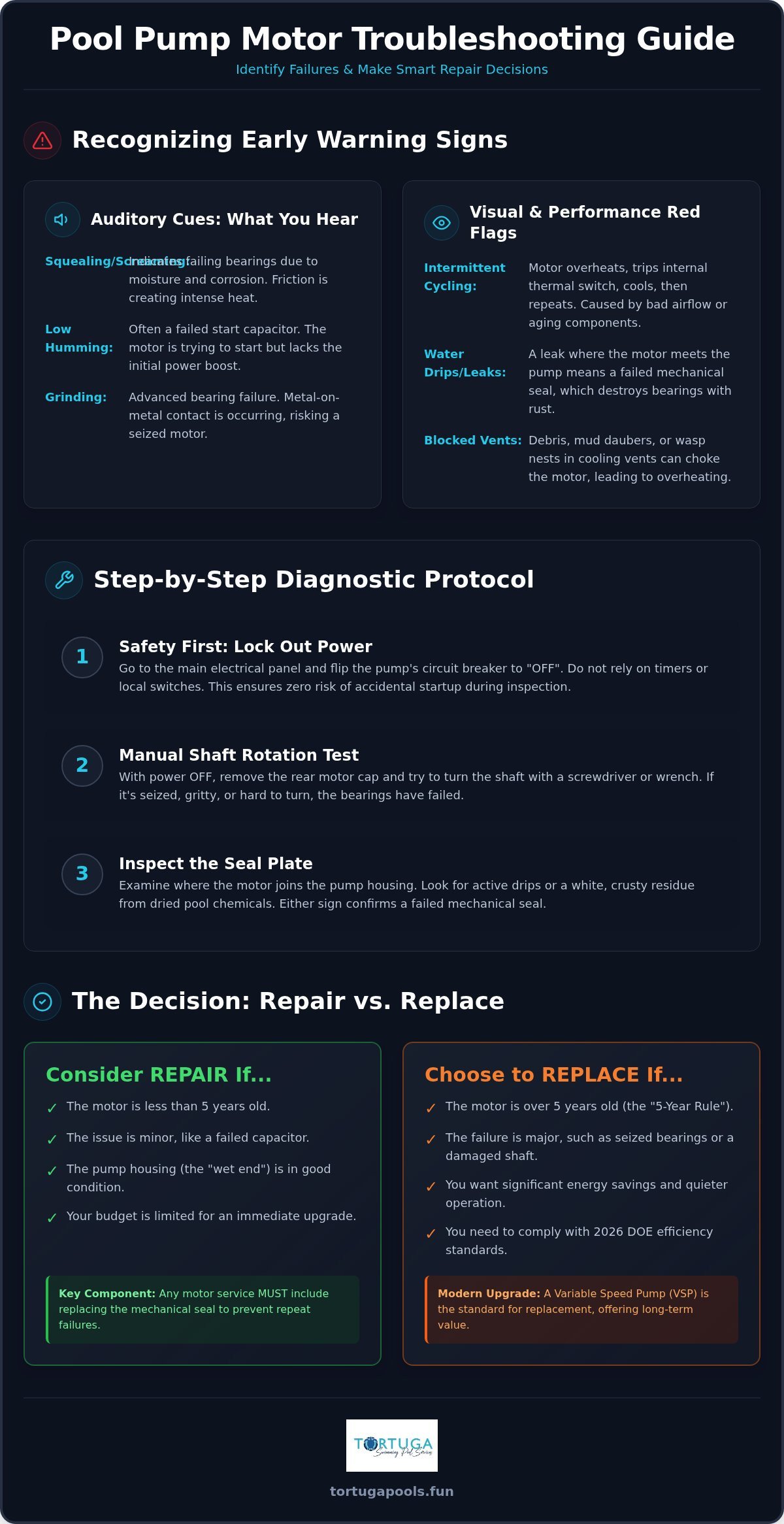
High-pitched squealing or “screaming” usually indicates failing bearings. Fulshear’s proximity to the Gulf Coast means moisture often penetrates the motor housing, leading to internal corrosion. Once the grease in the bearings dries out or becomes contaminated by this local humidity, metal-on-metal friction creates a distinct, loud noise. If ignored, the friction generates enough heat to weld the bearings to the shaft, resulting in a seized motor.
Texas summers are particularly brutal on electrical equipment. Thermal overload occurs when the motor reaches a temperature that risks permanent damage. The internal thermal switch will trip, shutting the unit down to protect the windings. It might restart once it cools, but this intermittent cycling is a clear signal that a pool pump motor repair Fulshear specialist should evaluate the system. Consistent overheating often stems from poor airflow or aging internal components that are drawing too much amperage.
Water leaks at the seal plate are the primary cause of premature motor failure. Look at the area where the motor meets the pump housing. A drip here is a silent killer. Water travels down the shaft and enters the front bearing, causing rapid rust. This is a disciplined maintenance point; catch the leak early, and you might save the motor.
Auditory Cues: Deciphering Grinding, Squealing, and Humming
It’s vital to distinguish between different sounds to avoid unnecessary repairs. A thumping or rattling sound often points to a clogged impeller or debris in the pump basket rather than a motor failure. A low humming sound, however, usually indicates a failed start capacitor. This component acts as a temporary battery to kickstart the motor into motion. You can safely isolate motor noise by using a long screwdriver as a stethoscope. Place the tip against the motor housing and your ear against the handle; this technique allows you to hear the internal bearings without the interference of ambient wind or water noise.
Visual and Performance Red Flags
A visual inspection should be part of your monthly routine. Check the cooling vents at the bottom and back of the motor for debris. In Fulshear, mud daubers and wasps frequently build nests in these warm, protected spaces, which chokes the motor’s ability to cool itself. Another red flag is the presence of air bubbles in the pump basket. While this can indicate a leak in the suction line, it’s also a sign of a failing shaft seal. When the seal loses its integrity, it can pull air into the system before it begins to leak water out. Monitoring these small changes is a protective measure that ensures the longevity of your equipment. A complete backyard safety review should also include your underwater lighting; water visible behind the lens or a flickering fixture are warning signs that warrant a professional pool light repair service inspection to protect both your equipment and your family.
Step-by-Step Diagnosis: A Methodical Protocol for Fulshear Homeowners
Safety is the foundation of any technical work. Before you begin inspecting your equipment, you must establish a secure environment by locking out the circuit breaker. Don’t simply turn off the timer or the local switch. Go to the main electrical panel and flip the breaker to the “off” position to prevent accidental activation. This disciplined approach protects both you and the delicate internal windings of the motor during the diagnostic process.
A methodical pool pump motor repair Fulshear diagnosis involves verifying the physical integrity of the pump’s moving parts. With the power safely disconnected, attempt to manually rotate the motor shaft. Most motors have a slot at the rear of the shaft accessible by removing a small cap. If the shaft won’t budge or feels “gritty,” the internal bearings have likely seized due to moisture intrusion. While you’re performing this check, inspect the area where the motor connects to the pump housing. The presence of a white, crusty buildup is a clear indicator of dried pool chemicals. This residue confirms that the mechanical seal has failed, allowing chlorinated water to leak directly into the motor’s front bearing.
Testing the Start and Run Capacitors
Capacitors act as a temporary battery, providing the high-torque surge necessary to start the motor. In Fulshear, our frequent summer thunderstorms often create power fluctuations that can easily damage these components. A failed capacitor is a common reason for a motor that hums but won’t spin. Look for visual cues like a bulging top or fluid leaking from the casing. Testing these requires caution; capacitors store an electrical charge even when the power is disconnected. They must be safely discharged with an insulated screwdriver before handling. Understanding The Repair vs. Replace Dilemma starts here. Replacing a capacitor is a simple fix, but it’s often a temporary solution if the motor is over five years old.
Inspecting the Impeller and Diffuser
Sometimes the motor isn’t the problem. A single pebble or a collection of pine needles can jam the impeller, creating symptoms that mimic a seized motor. You can often clear these obstructions by reaching through the pump’s intake after removing the basket. Additionally, inspect the diffuser for signs of heat warping. This typically occurs during “run-dry” scenarios where the pump lost prime and the water inside became hot enough to melt plastic components. Deformed parts will cause significant vibration and efficiency loss. If your diagnosis reveals complex internal damage, a professional equipment diagnosis can provide the technical verification needed to ensure a long-term resolution.
The Repair vs. Replace Dilemma: Efficiency and Long-Term Value
The decision to fix or replace a failing system requires a disciplined evaluation of long-term costs. Many homeowners apply the “5-Year Rule” when considering pool pump motor repair Fulshear. If your motor is less than five years old and the pump housing, or “wet-end,” remains in excellent condition, replacing the motor is often a sound investment. However, once a motor exceeds the five-year mark, internal components like the impeller, diffuser, and seal plate have likely suffered years of chemical exposure and heat. Mounted onto a warped housing, a new motor will fail quickly. Precision is mandatory.
Efficiency standards have shifted the landscape significantly. As of September 29, 2025, Department of Energy regulations effectively phase out the sale of traditional single-speed pumps for most residential pools. These standards prioritize high-performance variable-speed models that meet a minimum Weighted Energy Factor (WEF) of 3.8 to 4.0. When you factor in that a variable-speed pump can reduce energy consumption by 70 to 90 percent compared to older models, the return on investment often occurs within 12 to 18 months. Following a Professional Repair Protocol ensures that any electrical work meets federal safety standards, but it also highlights the technical gap between aging single-speed units and modern efficiency.
When to Choose Motor Repair
Repairing the existing motor is the most stable choice when the failure is isolated to a minor component. If the diagnostic protocol identifies a blown start capacitor or a leaking shaft seal on a relatively new system, there’s no need to replace the entire unit. This approach respects your budget while maintaining the integrity of a system that still has years of service life remaining. It’s a pragmatic, protective measure for homeowners who have performed consistent maintenance and have a pump housing that shows no signs of heat warping or structural cracks.
The Argument for Full Pump Replacement
The transition to Variable Speed (VS) technology is particularly beneficial for the local climate. Fulshear summers demand high filtration rates, which typically force single-speed pumps to run at maximum power for 10 to 12 hours a day. VS pumps allow you to dial back the RPMs during off-peak hours, using only one-eighth of the electricity at half speed. This methodical control extends the life of the motor and integrates seamlessly with modern pool automation systems. These smart platforms allow you to manage schedules and water chemistry from a smartphone, ensuring your oasis remains clear with minimal manual intervention.
Professional Repair Protocol: Ensuring Precision and Safety
Executing a professional repair requires a disciplined sequence of events. It’s not enough to simply bolt a new motor onto an old pump. You must ensure that every connection is verified and every seal is seated with absolute precision. This methodical approach is what separates a temporary fix from a long-term solution. When performing a pool pump motor repair Fulshear, we prioritize stability and endurance over speed. Every component is tested to ensure it meets the high standards required for the local climate.
The Critical Role of the Shaft Seal
A mechanical shaft seal is a $30 component that acts as the primary protector for a motor that can cost $500 or more. Never reuse an old seal. Even if it looks intact, the compression set from its previous installation makes it unreliable for a new motor. We follow the “clean hands” rule during installation. Touching the ceramic or carbon seal faces with bare fingers leaves behind skin oils. These oils can cause hotspots and premature failure. For pools using saltwater chlorination, we use upgraded seals made of specialized materials to resist chemical degradation and ensure a leak-free environment. Saltwater systems introduce unique stresses on all equipment components, and homeowners relying on these systems should also be aware of when a pool salt cell replacement Katy technicians recommend becomes necessary to maintain proper chlorine generation.
Precision alignment is equally vital. Vibration is a silent killer of motor bearings. We ensure accuracy by cross-tightening the motor bolts in a specific sequence, much like tightening the lug nuts on a vehicle tire. This prevents the motor from sitting at a slight angle, which would cause uneven wear on the internal shaft. Once the physical installation is complete, we move to electrical verification. This involves testing the incoming voltage and measuring the amperage draw under load to confirm the motor is operating within its designed parameters.
Wiring and Grounding for Texas Storms
Fulshear’s heavy seasonal rains and lightning activity make proper grounding and bonding essential for safety. We verify the solid copper bonding wire is securely attached to the motor’s bonding lug. This prevents galvanic corrosion and ensures the safety of everyone in the water. We also inspect the electrical conduit for small cracks that could allow moisture ingress during a downpour. Moisture inside the wiring compartment is a frequent cause of short circuits in our area.
Finally, we test the Ground Fault Circuit Breaker (GFCB) for a proper trip response. This is a critical safety verification that protects your family from electrical faults. We also recommend using NEMA-rated motor covers to shield the equipment from direct sun and high humidity. If your system requires this level of technical care, you can schedule a professional equipment repair to ensure your pool remains safe and operational throughout the year.
Selecting a Trusted Fulshear Partner for Pool Equipment Care
Fulshear homeowners value reliability and consistency. Choosing a local expert for pool pump motor repair Fulshear ensures your technician understands the specific wear patterns caused by our Gulf Coast environment. Neighborly accountability is a real thing here. We aren’t just a service provider; we’re protective stewards of your property’s stability. Our family-owned business treats your equipment pad with the same disciplined respect we give our own, prioritizing longevity over temporary fixes.
Why Fulshear Homeowners Trust Tortuga Pools
Our approach centers on a disciplined resolution for every mechanical failure. We don’t believe in high-pressure sales or rushing through a diagnosis. Instead, we use a technical checklist to identify the root cause of motor stress, whether it’s local humidity or electrical fluctuations from Texas storms. This expertise is built into our weekly pool maintenance services, where we monitor your equipment for early warning signs. Catching a failing bearing or a leaking seal early prevents the need for a total system overhaul later.
When a pump fails, the clock starts ticking on your water chemistry. In the peak of a Fulshear summer, an idle pool can turn green in less than 48 hours. Emergency support is about more than just mechanical repair; it’s about protecting your home’s health and safety. We offer emergency repair services to ensure your filtration system is restored before algae can take hold. Our methodical diagnostic protocol remains rigorous even in urgent situations, ensuring the repair is done correctly the first time.
Restoring Your Backyard Peace
A functioning pool pump should be felt, not heard. Restoring that quiet, steady hum is essential for your family’s comfort and backyard peace. Our team bridges the gap between specialized leak detection and mechanical equipment repair. This ensures that every part of your circulation system works in harmony, from the suction lines to the motor bearings. If you suspect your motor is failing or you’ve noticed a drop in water clarity, a professional inspection is the most stable next step. Schedule your pool pump motor repair in Fulshear today.
Securing the Long-Term Health of Your Fulshear Pool
Maintaining a crystal-clear oasis in the Texas heat requires a disciplined approach to equipment care. By identifying early warning signs like bearing noise and moisture leaks, you protect your system from catastrophic failure. Whether you’re weighing the benefits of a pool pump motor repair Fulshear or deciding on a full variable-speed upgrade, making an informed choice ensures the long-term stability of your backyard environment. Precision in every mechanical seal and electrical connection is what ultimately prevents recurring issues and unnecessary equipment costs.
As a family-owned business with deep local roots, we understand the specific challenges Fulshear weather presents to your equipment. We specialize in everything from green pool recovery to technical equipment repair. If your pump has failed, don’t wait for the water to turn; our emergency repair response is designed to provide a steady hand when you need it most. We invite you to Request a Methodical Equipment Diagnosis from Tortuga Pools today. Your pool deserves the thoroughness and care that only a neighborly expert can provide.
Frequently Asked Questions
How much does it typically cost to repair a pool pump motor in Fulshear?
Repairing a pool pump motor in the Texas market generally involves costs between $300 and $700 depending on the failure’s severity. Minor tasks like replacing seals or fixing small leaks typically fall between $150 and $300. These figures represent industry averages for labor and parts. A professional diagnostic inspection is the most accurate way to determine the specific requirements and technical needs for your equipment pad.
Is it better to repair a pool pump motor or replace the whole pump?
Choosing between repair and replacement depends on the age of your system and current efficiency standards. If your motor is over five years old, a full replacement with a variable-speed model is often more economical due to long-term energy savings. New 2026 federal regulations prioritize these high-efficiency upgrades. However, a newer system with a minor component failure, such as a capacitor, remains a strong candidate for a simple repair.
Why is my pool pump motor making a loud screeching noise?
A loud screeching or “screaming” noise is almost always a sign of failing internal bearings. Fulshear’s high humidity often causes moisture to penetrate the motor housing, leading to rust and the depletion of bearing grease. This metal-on-metal friction creates the high-pitched sound you hear. Ignoring this warning sign will eventually lead to a seized motor. Replacing the bearings early can sometimes save the unit before permanent damage occurs.
Can a pool pump motor be damaged by a Fulshear lightning storm?
Yes, lightning storms frequently cause electrical surges that damage sensitive motor components. The start capacitor is the most common victim of these power fluctuations. It often bulges or leaks after a significant weather event. In some cases, a direct or nearby strike can fry the internal windings of the motor entirely. We recommend verifying your GFCB and bonding wire integrity after any major storm to ensure continued safe operation. The same storms that damage your motor can also compromise your underwater lighting circuits, so a post-storm check with a qualified pool light repair service is a smart protective measure for your entire electrical system.
How long does a typical pool pump motor last in the Texas climate?
A standard pool pump motor in the Texas climate typically lasts between five and eight years. The intense summer heat and high humidity levels in our region put significant stress on electrical windings and mechanical seals. Consistent maintenance, such as keeping cooling vents clear of debris and wasps, can extend this lifespan. However, once a motor reaches the eight-year mark, internal wear often makes a pool pump motor repair Fulshear less cost-effective than an upgrade.
What happens if I run my pool without a functioning pump for a few days?
Running a pool without a functioning pump leads to stagnant water and a rapid decline in sanitation levels. Without circulation, chlorine isn’t distributed evenly, allowing algae to bloom within 24 to 48 hours during peak summer temperatures. Stagnant water also becomes a breeding ground for mosquitoes. Restoring the flow quickly is a protective measure for your family’s health and prevents the need for an expensive green pool recovery process.
Can I replace the pool pump motor capacitor myself?
While some homeowners attempt this, replacing a capacitor involves significant electrical risks. Capacitors store a high-voltage charge even after the power is disconnected. They must be safely discharged using specialized tools to prevent a dangerous shock. Additionally, any electrical work on pool equipment in Texas must be performed by a licensed technician with a Residential Appliance Installer License. Professional verification ensures the new component matches the motor’s technical specifications exactly.
Does Tortuga Pools offer emergency pool pump repairs in Fulshear?
Yes, Tortuga Pools provides emergency repair services for mechanical failures in the Fulshear area. We understand that a down pump is a threat to your water chemistry and backyard peace. Our methodical approach ensures that even urgent repairs are handled with disciplined care and technical precision. Whether you need a pool pump motor repair Fulshear or a full equipment installation, our team is ready to restore your system’s stability and clarity. For saltwater pool owners, our expertise also extends to diagnosing chlorination issues, including determining when a pool salt cell replacement Katy area homeowners need is the true source of declining water quality.