Your pool isn’t truly finished the moment the water reaches the tile line. Those first thirty days are a high-stakes chemical marathon that determines whether your plaster stays smooth or ends up with permanent, unsightly stains. It’s a period where one wrong move can void your warranty. This is why a professional pool startup service new home is the most important investment you can make after construction ends. You’ve likely felt the pressure of getting this right, especially with Katy’s hard water posing a constant threat to new surfaces. We understand that you want a backyard oasis that’s safe for your family, not a source of constant maintenance anxiety.
This process is about more than just a quick cleaning. It’s a disciplined, 30-day commitment to protecting your pool’s finish and ensuring long-term equipment stability. In this guide, we’ll provide a methodical checklist tailored for homeowners in Katy, Fulshear, and the Houston area. You’ll discover the exact steps required to balance your water chemistry, verify your equipment’s performance, and establish a maintenance rhythm that keeps your pool crystal clear for years to come. This is the steady hand approach your new home deserves.
Key Takeaways
- Understand why a professional pool startup service new home is vital for curing plaster correctly and protecting your structural warranty during the critical first 30 days.
- Learn the disciplined verification steps required before any chemicals are added to ensure your water chemistry starts from a stable, measured foundation.
- Master the Langelier Saturation Index (LSI) to achieve perfectly saturated water that prevents the local Katy water supply from etching or scaling your fresh finish.
- Identify the specific equipment risks, such as premature salt or heater usage, that can lead to permanent plaster dust hardening and surface damage.
- Discover how “Pool School” provides you with the technical confidence to manage your specific equipment and maintain long-term water stability.
The Critical First 30 Days: Why Your New Pool Needs a Professional Startup
The first thirty days of a pool’s life are not about swimming. They are about chemistry. A brand-new pool is a living, reacting environment where the water and the finish are in a constant state of chemical exchange. A professional pool startup service new home provides the methodical oversight needed to transform raw plaster into a durable, glass-smooth finish. Standard weekly maintenance is designed for stable, established water. It is simply not equipped to handle the aggressive pH spikes and calcium leaching that occur during the initial hydration phase. Without a disciplined approach, the very water intended to fill your pool can become its greatest enemy.
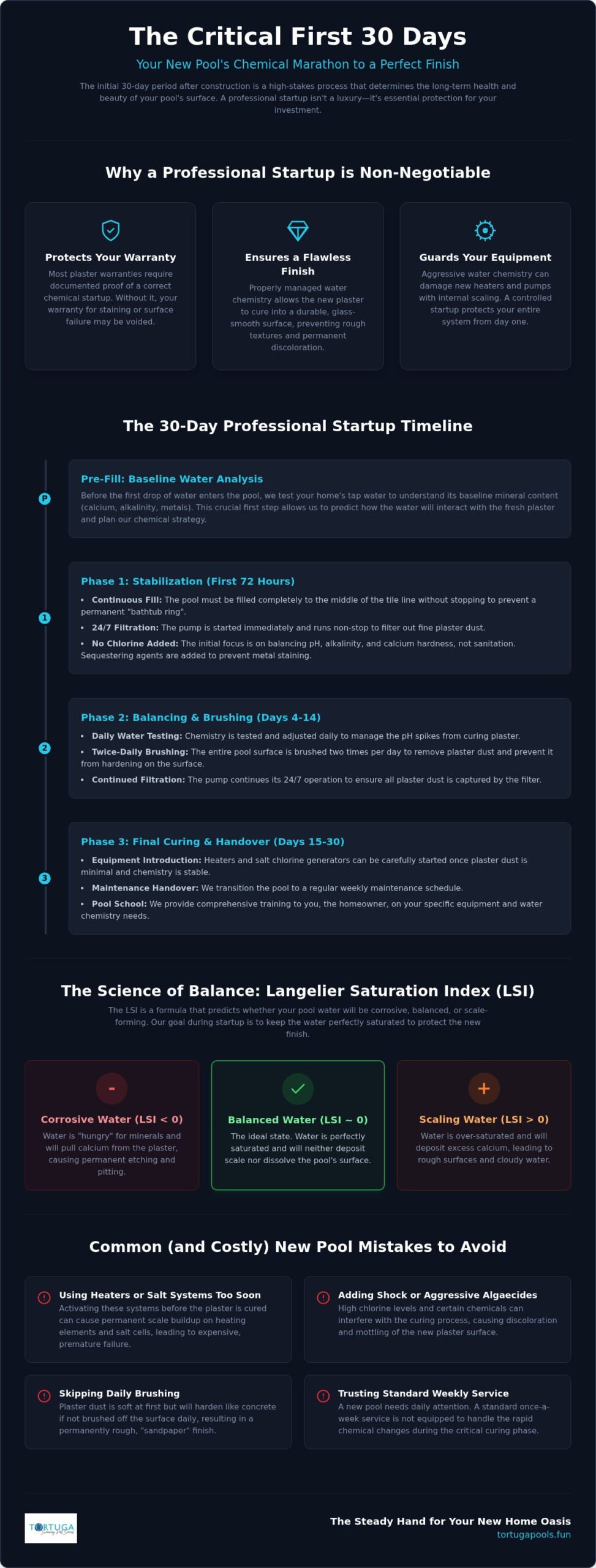
Many homeowners in Katy and Fulshear don’t realize that plaster warranties are often conditional. Most manufacturers require documented startup records to prove the water was balanced correctly from the moment of the first fill. If you cannot produce a log showing that the chemistry was maintained within strict parameters during the first week, the warranty for spotting, etching, or delamination may be voided. It is a significant financial risk for a new investment. We act as the steady hand, providing the verification and documentation necessary to protect your property and your peace of mind.
The Science of Plaster Curing
New plaster is chemically active. It is “hot.” As it cures underwater, it releases calcium hydroxide into the pool. This process spikes the pH and alkalinity within hours of the fill. Without a steady hand to monitor these levels daily, the water becomes aggressively scale-forming. This results in rough textures or permanent discoloration. Using the Langelier Saturation Index (LSI) allows us to calculate exactly how the water will interact with the plaster. We balance the water to be slightly undersaturated. This prevents calcium from plating out on the surface while the finish achieves its final hardness. Precision is the only way to avoid the sandpaper effect.
Fresh Fill vs. Seasonal Opening
There is a fundamental difference between a seasonal pool opening service and a new home startup. A seasonal opening focuses on clearing winter debris and re-establishing chlorine levels for an existing pool. A new build startup is far more intensive. It requires 24/7 pump operation for the first 14 to 28 days to filter out fine plaster dust. We avoid heavy chlorine dosages initially. Instead, we prioritize sequestering agents that keep metals and minerals in suspension. This protects your new heater and pump from internal scaling before they even finish their first month of service. It is a protective measure for your home and family.
The Essential New Pool Startup Checklist: From Fresh Fill to First Swim
Watching your new pool fill with water is a major milestone for any homeowner. However, the transition from a construction site to a family oasis requires more than just a garden hose and patience. A professional pool startup service new home follows a rigid, thirty-day timeline to ensure the surface cures without defects. This checklist isn’t a suggestion; it is a technical requirement for the longevity of your investment. We begin with verification. Before a single gallon enters the pool, we test your local Katy or Houston tap water to understand its baseline mineral content. This allows us to predict exactly how the water will react with the fresh plaster once the fill is complete.
Phase 1: The First 72 Hours
The fill process must be continuous. If the water stops before it reaches the middle of the tile line, it can leave a permanent “bathtub ring” on the plaster that is nearly impossible to remove. Once full, we immediately calculate the initial saturation levels. Our team verifies the equipment flow and starts the pump to begin the essential 24-hour filtration cycle. We don’t add chlorine during these first few days. The goal is stabilization and ensuring the plumbing is clear of construction debris. If you’re feeling overwhelmed by these technical requirements, our team is here to provide professional startup assistance to keep your project on track.
Phase 2: Days 4 through 14
This is the most labor-intensive phase of the checklist. Plaster dust, a byproduct of the curing process, must be removed through vigorous daily brushing. If left to sit, this dust can hydrate and harden, creating a rough, sandpaper-like texture on your pool floor. During this window, we gradually introduce chlorine and cyanuric acid. We follow the CDC’s pool operation guidelines to ensure the water eventually reaches safe disinfectant levels for your family. Constant pH monitoring is critical because curing plaster naturally pushes the pH higher every day. We act as the steady hand, neutralizing these spikes before they cause permanent scaling.
Phase 3: The Completion Window
By the third week, the plaster has achieved most of its structural integrity. We perform the first deep filter cleaning to remove the heavy accumulation of plaster sediment that the pump has captured. This is also when we calibrate high-end equipment. Salt cells and heaters remain off until the 30-day mark to prevent internal damage from the corrosive curing environment. The process concludes with a personalized “Pool School” session. We walk you through your specific equipment, showing you how to maintain the stability we’ve established. You aren’t just getting a clean pool; you’re getting the technical knowledge to protect your home for years to come.
Chemical Stabilization and the Langelier Saturation Index (LSI)
Chemical balance in a pool is not a suggestion; it is a mathematical requirement. For a pool startup service new home project, we utilize the Langelier Saturation Index (LSI) as our primary diagnostic tool. While many homeowners are familiar with the idea of “balanced” water, new plaster requires water that is “saturated” correctly. If the water is undersaturated, it becomes aggressive. It will leach calcium directly from your fresh finish to find equilibrium, resulting in permanent etching. Conversely, oversaturated water deposits excess minerals, leading to scaling. We don’t rely on gut feelings or estimations. We use precise measurements to ensure your water remains in the ideal range for curing.
Our approach is grounded in the reality that every fill is different. The water coming out of a tap in Katy might have a completely different chemical profile than water in Fulshear or central Houston. By using the LSI, we can account for variables like water temperature and cyanuric acid levels that standard testing often ignores. This level of detail is what separates a professional startup from a basic cleaning service. It is a protective measure designed to ensure the stability and endurance of your pool’s surface from day one.
Managing Calcium Hardness in Katy, TX
Homeowners in the Katy area face a specific challenge: high calcium levels straight from the tap. Local water reports frequently show hardness levels that are already near the top of the recommended range before a single chemical is added. When you fill a new pool with this water, the margin for error is slim. We act as the steady hand, monitoring these levels daily to ensure the water doesn’t become scale-forming as the plaster hydrates. If the calcium levels aren’t managed with technical precision, you risk seeing white, crusty deposits on your tile and plaster within the first two weeks. We verify these levels through rigorous testing to prevent these issues before they start.
PH and Alkalinity: The Balancing Act
New plaster is highly alkaline. It naturally drives pH levels upward as it cures during the first month. This isn’t a defect; it’s a chemical reality of the hydration process. We perform methodical testing at specific intervals to keep both pH and total alkalinity in check. Relying on DIY test strips is insufficient for a new build startup. Strips often lack the accuracy needed to calculate the LSI correctly, which can lead to improper dosing. We follow the rigorous maintenance standards established by the Pool & Hot Tub Alliance (PHTA) to ensure every measurement is verified. This professional-grade approach ensures your family is swimming in water that is chemically stable, clear, and safe for the long term.
Avoiding the “New Pool Blues”: Common Mistakes and Damage Risks
The excitement of a new backyard can often lead to costly shortcuts. While the water looks inviting, the underlying chemistry remains volatile during the first month. Engaging a professional pool startup service new home is the most effective way to prevent the “New Pool Blues.” One of the most common errors is the failure to manage plaster dust. If this fine sediment isn’t brushed daily, it can undergo a process called hydration, essentially gluing itself to the floor. This creates a permanent, rough texture that no amount of chemicals can fix later. Consistent, professional weekly pool maintenance in Katy, TX ensures these physical tasks aren’t neglected during the critical curing phase.
Another frequent oversight involves the use of automatic pool cleaners. You should never drop a robotic or suction cleaner into a pool during the first 30 days. The plaster is still achieving its final hardness. The wheels and brushes of these machines can leave permanent tracks or indentations on the soft finish. We take a protective stance, acting as a steward for your property by ensuring nothing touches the surface except a soft nylon brush until the curing process is complete.
The “First Swim” Impatience
We understand the desire to jump in immediately. However, swimming too early can disturb the delicate chemical balance we’ve established. Body oils, sunscreens, and organic waste react aggressively with water that hasn’t yet been stabilized. This can lead to sudden pH spikes and cloudiness. The finish is soft. It needs time. We typically recommend waiting until the water is professionally verified as balanced and the plaster dust has been fully filtered out. This patience ensures a safe environment for your family and a longer life for your pool’s finish.
Equipment Pitfalls
Equipment damage is a significant risk during an improper startup. Salt cells must remain off for the full 30-day window. Adding salt too early can be corrosive to the new plaster and can damage the cell itself. Similarly, running a pool heater before the water is perfectly balanced is a mistake. Aggressive water can leach copper from the heater’s heat exchanger, leading to internal failure and blue-green staining on your new plaster. Our goal is to ensure your pool pump repair Katy TX needs are zero by starting your system with a steady, methodical hand. If you want to ensure your investment is protected from day one, contact us to schedule your startup verification.
The Tortuga Method: Professional Startup and “Pool School”
The Tortuga Method is built on the philosophy of a steady hand. We believe that a pool startup service new home project requires a disciplined, thirty-day protocol that cannot be rushed or bypassed. Our approach is designed for longevity. It transforms a newly constructed shell into a stable, healthy aquatic environment for your family. This isn’t just about adding chemicals. It’s about a methodical transition from a construction project to a managed home asset. We take pride in our local accountability, ensuring that every pool in Katy, Fulshear, and Houston starts its life with the highest standards of care.
What to Expect from Our Startup Service
During the first month, our presence at your home is consistent and purposeful. We perform a series of scheduled visits that focus on the physical and chemical stabilization of the pool. Daily brushing is a core component of our service. It ensures that plaster dust is removed before it can harden. We conduct rigorous water testing at every visit, adjusting for the specific mineral challenges found in our local Texas water. We also provide a final verification of all equipment. This includes a methodical assessment of pool pump performance to ensure your system is operating at peak efficiency. Transparency is a hallmark of our method. You’ll receive clear communication after every visit, so you’re never left guessing about the status of your new investment.
Empowering the Homeowner: Pool School
Our service concludes with “Pool School.” This is a personalized education session designed to give you total confidence in your new system. We don’t just hand over a manual. We walk you through your specific automation, explain the function of every valve, and demonstrate how to manage your filtration system. You’ll learn how to spot early warning signs of chemistry shifts, which is vital in the intense Texas heat where evaporation can quickly alter your water balance. We provide basic safety tips and DIY checks that you can perform between our professional visits. This education ensures you aren’t just a pool owner; you’re a capable steward of your home’s newest feature.
Once the initial thirty-day curing period is complete, the focus shifts to long-term stability. The discipline we establish during the startup phase provides the perfect foundation for weekly pool maintenance. By choosing a methodical path from day one, you protect your warranty and ensure your pool remains a source of relaxation rather than a technical burden. It’s a professional reassurance that only a neighborly, local expert can provide. We’re here to ensure your pool remains crystal clear and safe for your family for years to come.
Securing Your Backyard Investment for the Long Term
Protecting your new pool requires a disciplined approach that extends far beyond the initial fill. By prioritizing a methodical 30-day curing protocol and expert LSI balancing, you prevent permanent surface damage and early equipment failure. This period of careful stabilization is the only way to navigate the specific challenges of Katy’s hard water while keeping your structural warranty intact. We understand that the transition from construction to relaxation can feel overwhelming, but it doesn’t have to be a source of anxiety.
A professional pool startup service new home provides the documentation and verification needed to protect your investment from the very first day. As a local Katy family-owned business, we act as the steady hand that guides you through the complexities of Pool School and initial maintenance. We’re committed to neighborly accountability and high standards. Schedule Your Methodical Pool Startup Service with Tortuga Pools today to ensure your family’s oasis is built on a foundation of reliability and expert care. Your new pool is ready to become a source of lasting memories; let’s ensure it stays beautiful for years to come.
Frequently Asked Questions
How long after a new pool is filled can you swim?
You should typically wait at least 14 to 28 days before the first swim. This delay allows the plaster to achieve sufficient structural hardness. Swimming too early introduces body oils and sunscreens that can react with the volatile chemistry of curing plaster, leading to cloudiness or surface staining. Our pool startup service new home protocol ensures we verify the water is safe for your family and the pool finish before you jump in.
Why do I have to brush my new pool every day?
Daily brushing is necessary to remove plaster dust that naturally occurs as the finish hydrates. If this fine sediment remains on the floor, it can undergo a process called hydration where it hardens and bonds to the surface. This creates a permanent, sandpaper-like texture that is uncomfortable for swimmers. Brushing twice a day for the first two weeks is the standard methodical approach we use to ensure a glass-smooth finish for your pool.
When can I turn on my salt cell for a new pool?
You must wait a full 30 days before adding salt or activating your salt chlorine generator. Curing plaster is sensitive to high salt concentrations, which can lead to permanent surface defects or scaling. Additionally, the aggressive chemical environment during the first month can damage the delicate electrolytic plates within the cell. We keep the system off during the startup phase, relying on liquid chlorine to manage disinfection while the finish achieves its final strength.
Can I use my pool heater immediately after a fresh fill?
Do not turn on your pool heater for at least 30 days after a fresh fill. New plaster drives the pH and alkalinity to levels that are often corrosive or scale-forming. If you run the heater before the Langelier Saturation Index is stabilized, you risk damaging the copper heat exchanger. This can lead to internal equipment failure and blue-green copper stains on your new plaster. We verify equipment stability before authorizing any heater usage.
What is the Langelier Saturation Index (LSI) and why does it matter for my startup?
The Langelier Saturation Index (LSI) is a mathematical formula used to determine if your water is corrosive, balanced, or scale-forming. For a new pool startup, standard balanced chemistry isn’t precise enough. We use the LSI to calculate how the water will interact with the fresh plaster. This allows us to keep the water slightly undersaturated, which prevents the finish from leaching minerals or developing unsightly calcium scale. It is the gold standard for surface protection.
Does a new pool startup affect my builder warranty?
Yes, an improper startup is one of the most common reasons for a voided plaster warranty. Most manufacturers and builders require documented logs of water chemistry, specifically pH and alkalinity, during the first thirty days. If you cannot prove the water was maintained within strict parameters, claims for etching or discoloration may be denied. Our methodical service provides the verification and documentation necessary to keep your structural and surface warranties fully protected.
How often should the filter be cleaned during a pool startup?
Your filter should be cleaned at least once at the end of the initial 30-day startup period. During the curing process, the pump captures a significant volume of fine plaster dust and construction sediment. This material can quickly clog the filter media, reducing flow and putting unnecessary strain on your equipment. We perform a deep filter cleaning as part of our final verification to ensure your system is clear and ready for regular weekly maintenance.
Is the water in Katy too hard for a new pool finish?
The water in Katy and Fulshear is known for high calcium hardness levels directly from the tap. While this water is hard, it is not inherently bad for a new pool finish if managed correctly. The challenge lies in the slim margin for error. We use precise chemical adjustments to ensure the high mineral content doesn’t lead to scaling on your new plaster. Our expertise in local Texas water chemistry ensures your pool stays crystal clear.