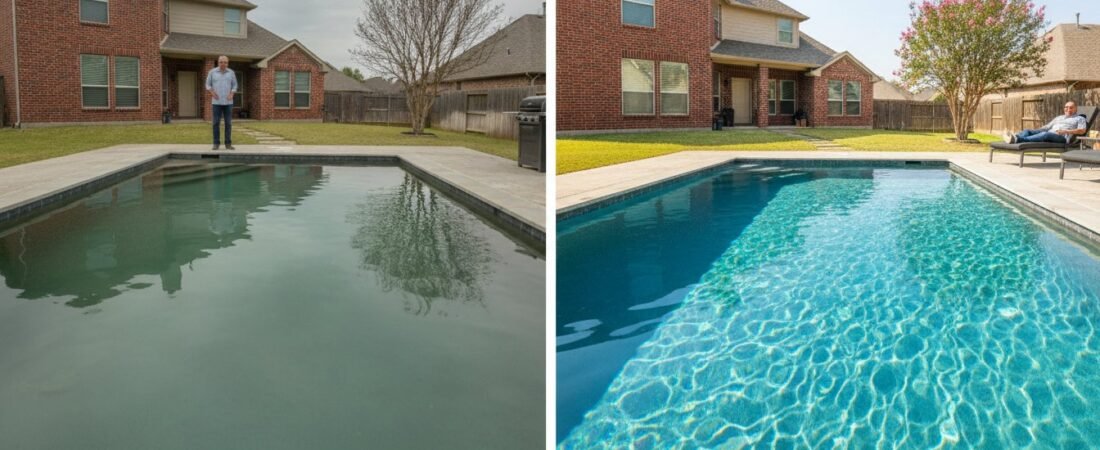
The chemical you think will save your pool for Saturday’s party might actually destroy your cartridge filter by Friday night. It’s a common mistake that leads to expensive equipment repairs and wasted weekends. You’ve likely balanced the chlorine and adjusted the pH, yet the water remains stubbornly dull. We understand the frustration of staring at a cloudy deep end when guests are arriving in forty-eight hours. Choosing between a pool flocculant vs clarifier isn’t about guesswork. It’s about understanding the specific chemistry of your water and the mechanical limitations of your filtration system.
You deserve a solution that works the first time without risking your expensive DE or cartridge filters. This guide provides the precise differences between flocculants and clarifiers to help you restore crystal-clear water with professional efficiency. We’ll examine which treatment fits your timeline, how to protect your equipment, and the exact steps to transition from a “dull” pool to a backyard sanctuary. You’ll gain a disciplined maintenance routine that prioritizes long-term health over quick, superficial fixes. Let’s look at the methodical way to clear your water once and for all.
Key Takeaways
- Learn the critical differences in pool flocculant vs clarifier applications, including which chemical works with your filter and which requires manual vacuuming.
- Understand why pH and alkalinity must be balanced with precision before adding treatments to ensure microscopic particles coagulate effectively.
- Identify which treatment is safe for cartridge and DE filters to prevent permanent equipment damage or unnecessary filter cleanings.
- Discover a methodical “Green to Clean” strategy for rapid recovery when water clarity is too poor for standard filtration to resolve.
- Establish a consistent maintenance routine that prioritizes equipment longevity and professional-grade chemical stability over quick fixes.
Understanding Cloudy Pool Water: Why Your Pool Needs Chemical Assistance
Cloudy water isn’t just an aesthetic annoyance. It’s a suspension of microscopic particles, often referred to as colloids, that are too small for your pool’s filtration system to capture. In Katy, we face unique environmental challenges that contribute to this haze. Heavy rain runoff from Gulf storms frequently washes fine silt and organic debris into the water. High bather loads during our humid summers introduce oils and sweat. Even microscopic algae spores can bypass a filter that isn’t running at peak efficiency. When the water turns dull, the core issue is usually the size of these contaminants. They remain suspended because they are too light to sink and too small to be trapped by standard media.
The Particle Problem: Why Your Filter Fails
Every filter has a micron rating that determines the smallest particle it can stop. Sand filters typically catch particles down to 20 or 40 microns. High-end DE filters can reach 2 to 5 microns. However, many contaminants like dead algae or skin cells are significantly smaller than these thresholds. They simply circulate back into the pool through the return lines. Homeowners often try to “shock” their way out of this problem. While chlorine kills organic matter, it doesn’t remove the physical remains. If the water stays hazy after a shock treatment, you aren’t dealing with a sanitation issue; you’re dealing with a physical filtration failure. Distinguishing between organic debris and chemical imbalances is the first step in our methodical approach.
The Role of Coagulants in Water Clarity
To fix this, we use the principles of The Science of Coagulation and Flocculation. Coagulants act like chemical magnets. They carry a charge that attracts these microscopic particles, binding them together into larger clumps. Once these clumps reach a certain size, they can either be trapped by the filter or sink to the floor. This is where the debate of pool flocculant vs clarifier begins.
A clarifier is a maintenance tool designed for patience, while a flocculant is a heavy-duty solution for rapid recovery. Achieving lasting clarity requires more than just pouring in a bottle of chemicals. It starts with a professional pool chemical balancing service to ensure the water chemistry allows these coagulants to work. Without proper pH and alkalinity, even the best chemicals will fail to bond with the debris. We prioritize this disciplined, step-by-step philosophy to protect your equipment and ensure your family’s safety.
The Science of Pool Clarifiers: Slow and Steady Maintenance
A pool clarifier is a polymer-based solution designed to treat mild cloudiness without disrupting your daily routine. It acts as a coagulant, binding microscopic particles into larger masses that your filter can finally trap. This process mirrors the professional methods used in municipal systems to ensure water safety, as detailed in this CDC Explanation of Water Treatment. Unlike more aggressive chemicals, a clarifier works in the background while your pump circulates the water. It’s the “steady hand” approach to water clarity, favoring consistency over immediate, harsh reactions.
For Katy homeowners, clarifiers are often the first line of defense after a light rain or a busy weekend of swimming. Because these chemicals work slowly, they don’t require you to manually vacuum the pool to waste. This saves a significant amount of water, which is a disciplined choice for both your utility bill and the local environment. When weighing the benefits of pool flocculant vs clarifier, the clarifier stands out as the low-impact maintenance tool that prioritizes the long-term health of your filtration system.
How Clarifiers Work with Your Filtration System
These chemicals are essentially liquid magnets. When you add a clarifier, it travels through the plumbing and into the pool, grabbing hold of fine silt, oils, and organic matter. This clumping turns invisible haze into filterable debris. For busy families, the primary benefit is the “set it and forget it” nature of the treatment. You simply add the measured dose, keep the pump running, and let the equipment do its job. It’s a reliable way to maintain high standards of water quality without constant supervision. A clarifier is the ideal polymer-based solution for mild cloudiness where the floor of the pool is still visible.
Pros and Cons of Using Clarifier
The advantages of using a clarifier are rooted in convenience and equipment safety. It’s a low-effort process that requires no water loss and is safe for all filter types. This is especially important for cartridge filters, which can be easily damaged or permanently clogged by heavier chemicals. If you want a protective measure that keeps your water sparkling without the risk of equipment failure, a clarifier is the correct choice.
However, there are limitations to this methodical approach. It isn’t an overnight fix. Results typically take 12 to 48 hours to fully manifest as the water circulates through the filter media. It cannot resolve a “swampy” pool or heavy algae blooms. Additionally, overuse is a real risk. If you exceed the recommended dosage, the chemical can actually repel particles rather than attracting them. This is known as chemical reversal, and it will make your pool cloudier than when you started. Accuracy in measurement is vital to avoid this setback. If you’re unsure about the current state of your water chemistry, our weekly cleaning and maintenance experts can provide a methodical assessment to get your pool back on track.
Pool Flocculant: The Heavy-Duty Solution for Emergency Recoveries
While clarifiers are the steady hand of routine maintenance, pool flocculant, often called “floc,” is the heavy-duty tool reserved for emergency recoveries. It is a powerful coagulant designed to sink all suspended debris to the pool floor. We typically utilize this treatment in “Green to Clean” scenarios where visibility is near zero and the water is thick with organic matter. The visual result of a successful application is unmistakable: the water turns clear, but a thick, grey layer of “dust” settles at the bottom of the deep end. This process is essential for maintaining Pool Chemistry and Bather Safety when standard filtration is overwhelmed by heavy contamination after a Texas storm.
The Gravity Method: Sinking Particles to the Floor
Unlike clarifiers that work over several days, flocculant creates a rapid chemical reaction that forms heavy clumps called “flocs.” These clumps are physically too heavy to stay suspended and will sink to the floor within 8 to 12 hours. To achieve this, your pump must be set to the “Recirculate” position. This setting allows the chemical to mix thoroughly throughout the water column without ever entering your filter tank. It is important to understand that flocculant requires significant manual labor to be effective. Once the debris has settled, it must be physically vacuumed out of the pool. When weighing pool flocculant vs clarifier, remember that floc is a physical intervention that demands your time and attention.
The Risks of Flocculant to Your Equipment
Flocculant is an aggressive chemical. It should never run through a cartridge filter or a DE filter grid. The chemical is designed to bond to anything it touches, and if it bonds to your filter media, it will gum it up permanently. This creates restricted water flow and high tank pressure, which can lead to a pool motor replacement service if the system is forced to operate under these conditions. We treat your equipment with the same respect we treat our own, which is why we never take shortcuts with flocculant.
Removing the settled debris requires the “Vacuum to Waste” setting. This bypasses the filter entirely and sends the chemical-laden water out through the backwash line. Because you’re pumping water directly out of the pool, you’ll experience noticeable water loss and will need to refill the pool simultaneously. Always verify your pool has a multiport valve before starting this treatment. If you have a cartridge filter without a bypass plumbing line, using floc is a mistake that often results in an expensive equipment overhaul. Our methodical approach ensures we verify these technical details before a single drop of chemical is added to your water.
Pool Flocculant vs. Clarifier: Choosing the Right Treatment
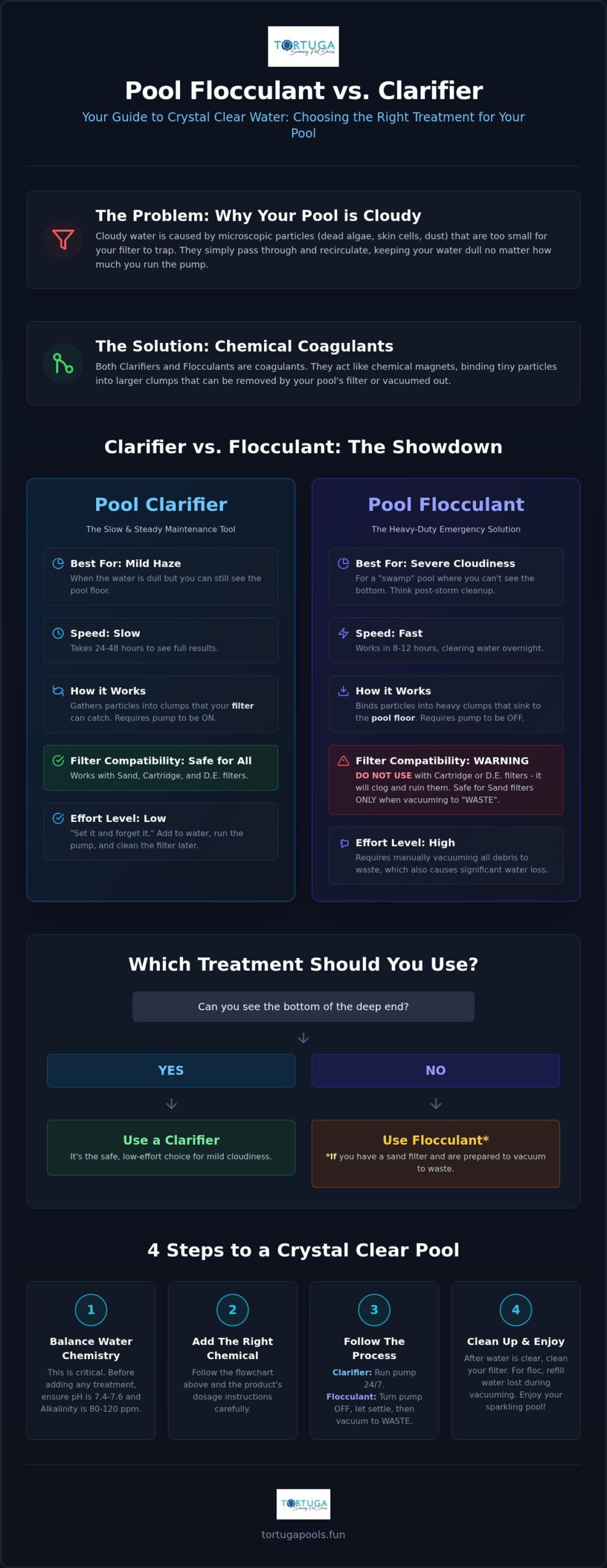
Comparing pool flocculant vs clarifier requires a disciplined look at your pool’s current condition and its mechanical limits. You aren’t just choosing a chemical; you’re choosing a maintenance process. A clarifier supports your filter’s natural function by binding particles over time. A flocculant replaces the filtration process entirely by sinking debris to the floor. We take a methodical approach to this decision to protect your equipment and ensure water stability.
- Sand Filter: Safe for both clarifiers and flocculants.
- DE Filter: Safe for clarifiers. Flocculant is safe only if your system has a multiport valve to bypass the grids.
- Cartridge Filter: Safe for clarifiers. Flocculant is prohibited as it will permanently gum up the pleated elements.
The Decision Matrix: Which One Do You Need?
The visibility of the pool floor is your primary diagnostic tool. If the water is hazy but you can still see the main drain at the bottom, a clarifier is the efficient choice. It treats the water over 12 to 48 hours with zero water loss. If the pool has become an opaque “swamp” after a heavy Katy storm, you need the aggressive sinking power of a flocculant. However, if you own a cartridge filter, you must avoid flocculant at all costs. The risk of ruining your expensive elements far outweighs the benefit of a quick fix. We always prioritize the longevity of your equipment over superficial speed.
Cost and Effort Analysis
Clarifiers are the most cost-effective solution regarding labor. They are “set it and forget it” chemicals that work while you go about your day. Flocculants are faster for clearing water, but they demand specialized knowledge and manual labor. You must vacuum the sediment to waste, which can lower your pool’s water level by several inches in under two hours. This process requires a constant, watchful eye on the pump to prevent it from running dry. We believe that consistent, professional weekly pool maintenance is the most reliable way to prevent these chemical emergencies. It ensures your water stays balanced and your equipment stays protected year-round.
For homeowners who want to skip the DIY trial-and-error and ensure their water is treated with professional precision, our weekly cleaning and maintenance team is ready to provide the steady hand your pool needs.
A Step-by-Step Method for Restoring Water Clarity
Restoring a pool’s luster requires a disciplined sequence of actions. Pouring chemicals into an unbalanced or dirty system is a waste of both time and money. To achieve professional results, you must follow a methodical process that prioritizes water chemistry and equipment readiness. Whether you have made your choice in the pool flocculant vs clarifier debate or are still weighing the options, these steps ensure the treatment actually works.
- Step 1: Establish the Chemical Foundation. Test and balance your pH and Total Alkalinity. Coagulants are sensitive to water balance. If your pH is not between 7.2 and 7.8, the particles will not bond effectively.
- Step 2: Optimize Filtration. Clean your cartridge filter or backwash your sand or DE filter. Maximum flow is required to move the treated water and capture clumps.
- Step 3: Precise Application. Add the chemical according to the manufacturer’s dosage. For clarifiers, keep the pump running on the “Filter” setting. For flocculants, set the pump to “Recirculate” for two hours to distribute the product, then shut the system off completely.
- Step 4: The Waiting Period. Allow the water to circulate for 24 to 48 hours for clarifiers. For flocculants, let the pool sit undisturbed for 12 to 24 hours until the debris settles on the floor.
- Step 5: Removal and Re-testing. Vacuum the debris. Use the “Filter” setting for clarifiers and the “Waste” setting for flocculants. Once the water is clear, re-test your sanitizer and pH levels to ensure the pool is safe for swimming.
The Methodical Vacuuming Technique
Vacuuming flocculant requires a steady hand and extreme patience. If you move the vacuum head too quickly, you will create a “cloud” of dust that redistributes the debris back into the water. Move in slow, deliberate passes. When vacuuming to waste, you’re pumping water directly out of the pool. It’s vital to keep a garden hose running to replenish the water level. If the water drops below the skimmer line, the pump will pull in air and potentially lose its prime. For homeowners facing a total “swamp” recovery, a professional green to clean pool service can handle this labor-intensive process with specialized high-powered equipment.
Preventing Future Cloudiness in Katy Pools
The humid Houston climate and frequent Gulf storms demand a proactive maintenance schedule. We recommend a deep filter cleaning every three to four months for cartridge systems to prevent microscopic buildup. After a typical Texas thunderstorm, check your chlorine levels immediately. Rainwater often introduces organic contaminants that consume your sanitizer, leading to the dullness that requires chemical intervention later. Adopting a “steady hand” approach through consistent residential pool maintenance prevents the need for heavy chemical treatments. By maintaining professional-grade balance every week, you protect your equipment and ensure your water remains crystal clear regardless of the weather.
Restoring Clarity with Professional Precision
Restoring your pool’s clarity isn’t about grabbing the strongest chemical on the shelf. It’s about matching the right solution to your specific filtration system and water condition. We’ve seen that the choice of pool flocculant vs clarifier often determines whether you’ll be swimming by the weekend or replacing expensive cartridge elements. A clarifier offers a steady path for mild cloudiness, while flocculant provides the heavy-duty sinking power needed for severe recoveries. Protecting your equipment through methodical chemical balancing remains the most reliable way to ensure long-term water stability.
If you’re struggling with a stubborn “swamp” or simply want to skip the DIY trial-and-error, our team is here to act as your steady hand. As a locally owned and operated business in Katy, TX, we specialize in complex equipment diagnosis and disciplined care. Every visit includes our methodical 12-point weekly inspection to keep your system running at peak efficiency. Get a Professional Green-to-Clean Quote from Tortuga Pools today. You can enjoy a crystal-clear pool without the stress of chemical guesswork.
Frequently Asked Questions
Can I use pool flocculant with a cartridge filter?
No. Flocculant is a thick coagulant that will permanently gum up the fine pleats of a cartridge filter. It restricts water flow and creates high tank pressure that can lead to motor failure. If you must use floc, you need a plumbing bypass that skips the filter entirely. Without this specialized bypass, a clarifier is your only safe chemical option to maintain equipment longevity and ensure a job done correctly.
How long do I have to wait to swim after using a clarifier?
You should wait at least 20 minutes for the chemical to disperse, but most professionals recommend waiting one full turnover cycle. This is usually 8 to 12 hours. Clarifiers are safe for swimmers because they are polymer-based and non-toxic. However, swimming too soon disrupts the coagulation process. For the best results, let the filter run undisturbed until the water achieves the crystal-clear clarity you expect for your family.
Why is my pool still cloudy after using a clarifier?
Persistent cloudiness often stems from unbalanced pH or alkalinity levels. Clarifiers cannot bond with microscopic debris if the water chemistry is off. Another common cause is a dirty filter that can no longer capture the clumped particles. If the floor remains invisible after 48 hours, the issue might be a pool flocculant vs clarifier mismatch where the contamination level is simply too high for a slow maintenance treatment to resolve.
Can I use flocculant and clarifier at the same time?
No. You should never mix these chemicals simultaneously. They use different methods to clear water and can work against each other, creating a gummy mess in your plumbing. If a clarifier fails to work after several days, you must wait for the chemical to filter out before attempting a heavy-duty recovery. A methodical approach requires using one treatment at a time to ensure your water remains stable and safe for your equipment.
Does pool flocculant kill algae?
Flocculant does not kill algae; it only helps remove the physical remains of dead algae. You must first use a sanitizer like chlorine to kill the bloom. Once the algae is dead and turns grey or white, the flocculant binds those suspended particles and sinks them to the floor for removal. Using floc on live green algae is a waste of resources and won’t stop the bloom from spreading through your water.
How much water will I lose when vacuuming to waste after floccing?
You can expect to lose between 3 and 6 inches of water during a thorough vacuum-to-waste session. The exact amount depends on the size of your pool and how much debris has settled on the floor. Because the pump is moving water directly out of the pool, you must keep a garden hose running to protect your skimmer. This water loss is the primary trade-off for the rapid results flocculant provides during emergency recoveries.
Is it better to use liquid or tablet clarifiers?
Liquid clarifiers are generally superior for rapid distribution and precise dosing. They begin working immediately as they circulate through the return lines. Tablets, or gel caps, are placed in the skimmer and dissolve slowly over several days. While tablets provide a steady dose for ongoing maintenance, liquid versions offer the industrial-strength performance required to address a dull pool after a heavy Houston thunderstorm. We favor the accuracy of liquid measurements for consistent results.
What happens if I accidentally run flocculant through my filter?
Running flocculant through your filter media can cause immediate and severe clogging. In sand filters, the sand may clump together, requiring a deep chemical soak or a full sand replacement. In cartridge or DE filters, the chemical bonds to the fabric or grids, often making them impossible to clean. If this happens, you should shut down the system immediately and seek professional equipment repair to prevent motor damage and ensure the safety of your system.