A crystal-clear pool isn’t the result of luck or expensive “quick-fix” chemicals; it’s the product of a disciplined, methodical routine. Most homeowners find themselves trapped in a cycle of reactive cleaning, where they spend their entire weekend scrubbing tiles or chasing the right pH balance. This 2026 swimming pool maintenance checklist is designed to end that frustration. By following a steady, step-by-step process, you can protect your investment and ensure your water remains safe and inviting for your family.
We understand the deep frustration of conflicting chemical advice and the persistent worry that a neglected filter might lead to a major mechanical failure. You deserve a stable, predictable routine that preserves your equipment and keeps your water pristine without demanding all of your free time. This guide provides a professional roadmap to help you act as a protective steward of your property with quiet confidence. We’ll walk you through daily inspections, weekly chemical verification, and the latest smart automation trends for 2026 to ensure your pool is always swim-ready.
Key Takeaways
- Learn how a disciplined schedule serves as your primary defense against algae and which essential tools are required for a professional-grade kit.
- Master our comprehensive swimming pool maintenance checklist to streamline your weekly cleaning, focusing on methodical skimming and thorough wall brushing.
- Discover the technical “order of operations” for chemical balancing to ensure your water remains stable, clear, and safe for your family.
- Protect your equipment by learning to establish a filter pressure baseline and using precise testing methods to identify hidden leaks.
- Gain specific insights for managing Texas climate challenges, from rapid post-storm debris removal to maintaining water levels during high evaporation.
The Methodical Pool Maintenance Schedule: Frequency and Tools
Consistency is the bedrock of pool health. It is the primary defense against invasive algae and the buildup of equipment scale. When you rush your maintenance, you create a cycle of chemical instability that is difficult to correct. A disciplined swimming pool maintenance checklist ensures every component receives the attention it needs. For a comprehensive overview of swimming pools and their complex sanitation requirements, it is evident that regular intervention is cheaper than emergency repair. In the Houston corridor, our heat and humidity mean that a single missed day can trigger a green pool crisis.
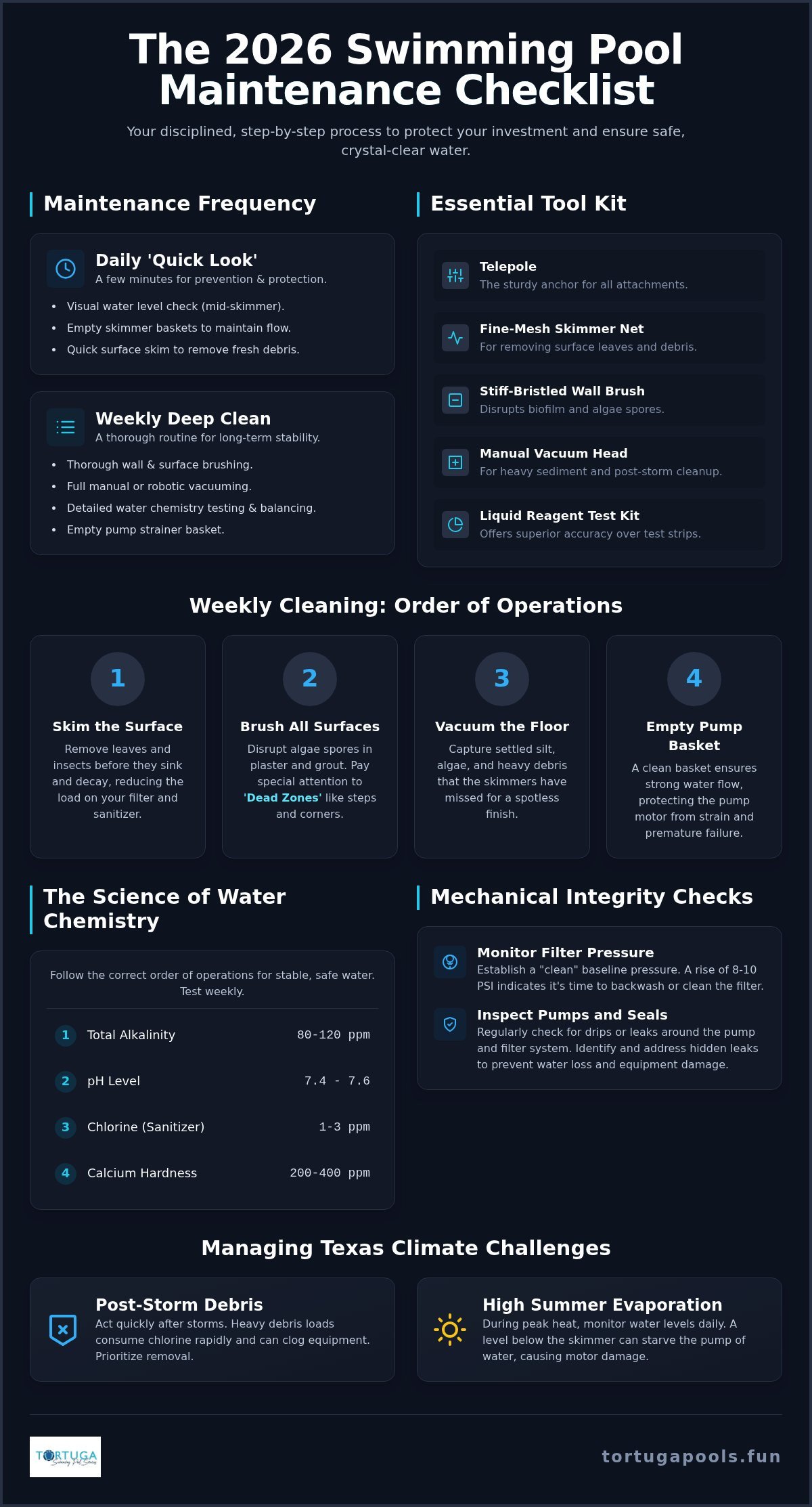
Your maintenance kit should be professional-grade. A sturdy telepole serves as the anchor for your other attachments. You need a fine-mesh skimmer net for surface debris and a stiff-bristled wall brush to disrupt biofilm. A manual vacuum head is essential for removing heavy sediment that automatic cleaners might miss. Weekly maintenance is a deeper commitment than your daily rounds. This is when you perform full-scale vacuuming and detailed chemical testing. While daily tasks take only minutes, the weekly swimming pool maintenance checklist requires a more unhurried, thorough approach to ensure long-term stability.
The Daily Maintenance ‘Quick Look’
Daily care focuses on mechanical protection and prevention. A visual water level check ensures it stays at the mid-skimmer point. If the level drops too low, the pump might pull in air, leading to cavitation and expensive motor damage. This is a common issue during the peak of a Texas summer. Emptying the skimmer basket daily maintains the proper flow rate necessary for effective filtration. Finally, a quick surface skim removes organic matter, such as leaves or insects, before they sink and decay on the plaster floor.
Essential Supplies Inventory
Accuracy starts with your inventory. Organize your storage area so chemicals are accessible but safely segregated. Never store muriatic acid directly next to chlorine products, as accidental mixing creates dangerous gases. We prefer liquid reagent testing kits because they offer superior accuracy compared to basic test strips. This precision allows for better chemical balancing and prevents the “trial-and-error” approach that wastes money. Safety is paramount; always use heavy-duty gloves and eye protection when handling concentrated chemicals. This methodical approach protects both your family and your equipment investment.
Weekly Cleaning Checklist: Removing Debris and Preventing Algae
A rigorous weekly cleaning routine is the only way to maintain a safe environment for your family. This phase of your swimming pool maintenance checklist moves beyond simple aesthetics. It focuses on the physical removal of organic contaminants. Start with a thorough surface skimming. This reduces the immediate load on your filtration system. By removing leaves and insects before they sink, you prevent them from decaying and consuming your chlorine. Adhering to CDC guidelines on healthy swimming requires this level of diligence to keep the water sanitary and clear.
The second step involves a deep brushing of all submerged surfaces. You must disrupt algae spores before they have the chance to take root in the plaster or tile grout. Following this, vacuum the floor to capture any settled silt or heavy debris that has bypassed the skimmers. The final critical step is emptying the pump strainer basket. A clogged basket restricts water flow. This puts undue stress on the pump motor and can lead to premature mechanical failure. For those who find these technical demands overwhelming, our weekly cleaning and maintenance provides a reliable alternative.
Brushing the ‘Dead Zones’
Algae thrives in areas where water circulation is restricted. These spots are often found behind ladders, under the lip of the pool tile, or within the deep corners of the steps. Dead zones are areas where water stagnates and algae begins. To combat this, use a methodical brushing technique. Always brush toward the main drain. This pushes the loosened debris and spores toward the filtration intake where they can be effectively removed from the system. This disciplined approach ensures that no section of your pool is left vulnerable to an outbreak.
Vacuuming for Clarity
While robotic cleaners are helpful for daily maintenance, they often lack the suction power required for heavy post-storm cleanup. Manual vacuuming provides the precision needed for a truly spotless finish. It is essential to prime the vacuum hose correctly. You must fill the entire hose with water before connecting it to the suction line. This prevents air locks that can cause your pump to lose prime and stop circulating water. This level of technical care is part of a comprehensive pool maintenance for busy homeowners strategy. It ensures your equipment runs efficiently and your water stays crystal clear all year long.
Following this swimming pool maintenance checklist helps you avoid the “green pool” emergencies that often plague the Katy and Houston area. Every step is designed for longevity and stability. When you treat your equipment with respect, it rewards you with years of trouble-free service. Consistency is the craftsman’s secret to a perfect pool.
The Science of Water Chemistry: Testing and Balancing
Water chemistry is a technical discipline that requires precision rather than guesswork. Achieving a safe, swim-ready environment depends on your ability to measure and adjust five specific data points. A professional swimming pool maintenance checklist must include verification of pH, Free Chlorine, Total Alkalinity, Calcium Hardness, and Cyanuric Acid (CYA). Each of these factors influences the others. If one is neglected, the entire system becomes unstable, leading to cloudy water or damage to your pool’s plaster and plumbing.
The “Order of Operations” is critical for chemical stability. You must always balance Total Alkalinity before attempting to adjust your pH. Alkalinity acts as a buffer. It prevents the pH from swinging wildly when you add other chemicals. We recommend maintaining Total Alkalinity between 80 and 120 parts per million (ppm). Once this foundation is secure, you can adjust your pH with confidence. For effective sanitation, keep your Free Chlorine level between 1 and 3 ppm. If you use a heavy dose of oxidizer, or “shock,” do so after the sun has set to ensure the chemical remains in the water long enough to destroy organic contaminants.
Understanding the pH-Chlorine Relationship
There is a direct synergy between pH and chlorine effectiveness. When your pH rises above 7.8, your chlorine becomes sluggish and loses its ability to kill algae and bacteria. This invites a “green pool” emergency even if your chlorine levels appear adequate. To lower your pH safely, use muriatic acid in small, measured increments. The CDC guidelines on healthy swimming suggest a pH range of 7.0 to 7.8. This range ensures the water is comfortable for swimmers and non-irritating to the eyes while maximizing sanitization power.
Stabilization with Cyanuric Acid
In the intense Texas sun, chlorine can vanish in as little as two hours without protection. Cyanuric Acid (CYA) acts as a “sunscreen” for your chlorine, shielding it from ultraviolet degradation. This is a vital component of weekly pool maintenance in Katy TX where heat levels are extreme. However, you must avoid over-stabilization. If CYA levels exceed 100 ppm, it can lead to “chlorine lock,” rendering your sanitizer ineffective. The only reliable way to lower CYA is to partially drain and refill the pool with fresh water. Using a methodical swimming pool maintenance checklist helps you monitor these levels closely to prevent such a costly correction.
Mechanical Integrity: Inspecting Pumps, Filters, and Seals
A comprehensive swimming pool maintenance checklist must extend beyond the water’s surface to the equipment pad. Your pump and filter are the heart and lungs of the system. Neglecting these mechanical components leads to poor circulation and eventual system failure. Start by establishing a baseline reading on your filter pressure gauge when the filter is clean. This number serves as your primary diagnostic tool. You should also monitor the pump motor for unusual grinding noises or excessive heat. These symptoms often signal bearing wear or an impending motor failure that requires professional intervention.
Air leaks on the suction side of the pump are a common yet avoidable nuisance. Inspect the pump lid O-ring and the gaskets on your valves for signs of cracking or dryness. Applying a silicone-based lubricant to these seals prevents air from entering the system. If you notice air bubbles returning through the pool jets, a compromised seal is likely the culprit. For complex mechanical issues that go beyond routine lubrication, our team provides specialized equipment repair to keep your system running at peak efficiency.
Filter Maintenance: Backwashing vs. Cleaning
Different filtration systems require specific maintenance protocols. If you own a DE or Sand filter, you must perform a backwash cycle when the pressure rises. Cartridge filters, however, need to be removed and deep-cleaned with a garden hose to restore flow. A 10 PSI rise above baseline indicates a dirty filter. Ignoring this threshold forces the pump to work harder. This reduces the lifespan of your equipment and increases your monthly energy costs. Maintaining a disciplined cleaning schedule ensures your water remains clear and your utility bills stay manageable.
The Equipment Walkthrough
Your weekly routine should include a methodical walkthrough of all peripheral equipment. Inspect your salt cell for white, flaky scale buildup that can hinder chlorine production. Similarly, check the heater for any signs of soot or debris that might obstruct the airflow. Verify that your timer or automation system settings are correct, especially after a power outage or a change in seasons. Finally, perform a bucket test if you suspect a leak. Place a bucket on the pool step and fill it to the water level. After 24 hours, compare the loss. If the pool water has dropped significantly more than the water in the bucket, you likely have a structural leak rather than simple evaporation.
Managing Texas Extremes: Storms, Heat, and Professional Care
The Gulf Coast climate presents challenges that a generic swimming pool maintenance checklist often overlooks. In the Katy and Houston corridor, we face intense humidity, sudden tropical downpours, and sustained 100-degree heat. These environmental factors accelerate chemical consumption and put extreme stress on your filtration system. Managing these variables requires a disciplined approach that anticipates local weather patterns rather than simply reacting to them. Proper care during these extremes prevents the “green pool” emergencies that often disrupt the swimming season. Consistency isn’t just about aesthetics; it’s about protecting your investment from the harsh Texas environment.
Texas Storm Response
Heavy rainfall is more than just extra water; it’s a source of contaminants. Nitrogen and phosphates often enter the pool during a storm, providing a feast for algae. You should check your chemical balance immediately after the clouds clear. Rainwater is typically acidic and will lower your pool’s pH and alkalinity levels. Simultaneously, high winds often clog pump baskets with organic debris. This restricts flow and can lead to motor overheating. We recommend shocking the pool after significant rain events to neutralize the sudden influx of organic matter and ensure your sanitizer remains effective.
The Tortuga Pools Advantage
There comes a point where the technical demands of a swimming pool maintenance checklist exceed the time a homeowner can realistically commit. Sustaining a “green-free” pool during a brutal Houston August requires meticulous care. If you find yourself spending more time testing water than enjoying it, professional intervention is a logical next step. Our team acts as a protective steward for your property, providing the steady hand needed for longevity and stability. We focus on the details that matter, from keeping the water level at the mid-skimmer point to identifying subtle mechanical issues before they become expensive failures.
We specialize in the complex tasks that keep a pool running efficiently for years. This includes expert leak detection to distinguish between normal evaporation and structural loss, as well as precise mechanical repairs for pumps and heaters. By choosing our professional weekly service, you reclaim your weekends and gain the peace of mind that comes from neighborly accountability. For those seeking consistency and high standards, contact Tortuga Pools for a steady hand in pool care. We treat your family’s investment with the same diligence we apply to our own, ensuring your water is always clear and your equipment is always protected.
Achieving Long-Term Stability for Your Pool
Maintaining a pristine swimming environment requires more than occasional skimming; it demands a disciplined commitment to the technical details. This swimming pool maintenance checklist provides the framework you need to protect your family and your equipment from the harsh Texas elements. By prioritizing the “order of operations” in your water chemistry and performing methodical mechanical inspections, you prevent the gradual degradation that leads to expensive failures. A stable routine is your best defense against the unpredictable nature of our local climate.
If you find that the demands of testing and cleaning are consuming your weekends, our team is here to act as a protective steward for your property. We bring family-owned reliability to every home in Katy and Houston. Whether you require specialized green-to-clean restoration or expert local leak detection, we provide the steady hand necessary for professional-grade results. You don’t have to manage the complexities of pool health alone. Secure your pool’s health with Tortuga Pools Weekly Maintenance and enjoy the peace of mind that comes from a job done correctly the first time. Your pool should be a source of relaxation, not a source of stress.
Frequently Asked Questions
How often should I really test my pool water?
You should test your water at least twice a week during the peak swimming season. In our local climate, heat and heavy usage can deplete chlorine levels in just a few hours. Frequent testing is a vital component of a swimming pool maintenance checklist to ensure your water chemistry remains within the safe ranges recommended by the CDC. Consistency here prevents the sudden algae outbreaks that often plague Houston homeowners.
Can I leave my pool pump running 24/7?
While it’s safe to run a pump 24/7, it’s rarely the most efficient choice for residential pools. Most systems only need to run for 8 to 12 hours to achieve a complete water turnover. We recommend running your pump during the hottest part of the day. This ensures that your sanitizer is properly distributed when the sun’s UV rays are most likely to degrade your chlorine.
What is the best way to clear a green pool quickly?
Clearing a green pool requires a methodical restoration process rather than a single chemical treatment. You must first balance the pH, then apply a heavy dose of chlorine shock to kill the algae spores. Once the algae is dead, use a flocculant to settle the debris to the floor and vacuum it directly to waste. For severe cases, professional Green-to-Clean services provide the most reliable and thorough results.
Is it safe to swim immediately after adding chemicals?
You should generally wait at least four hours after adding balancing chemicals like muriatic acid or soda ash. This allows the pump to circulate the water and ensures the chemicals are properly diluted. If you’ve applied a heavy shock treatment, avoid swimming until your testing kit confirms that Free Chlorine levels have returned to a safe range, typically between 1 and 4 parts per million.
How much water loss is normal for a pool in Houston?
Normal evaporation in the Houston corridor can result in a loss of roughly a quarter to a half inch of water daily. Factors like high wind and low humidity can increase this rate. If you suspect a problem, use the bucket test mentioned in our swimming pool maintenance checklist. This simple verification method distinguishes between natural environmental loss and a more serious structural leak that requires mechanical repair.
What happens if I forget to clean my skimmer basket?
A clogged skimmer basket acts as a dam that restricts the flow of water to your pump. This restriction can cause the pump to pull in air, leading to cavitation and significant motor damage. Regularly emptying the basket is a small but critical task. It protects your mechanical investment and ensures that your filtration system can effectively remove surface debris before it sinks to the floor.
Do I need to shock my pool every week?
Weekly shocking is a protective measure that helps eliminate organic contaminants and combined chlorines. It’s especially important during the summer months when bather loads are high or after a typical Texas thunderstorm. By oxidizing the water once a week, you ensure that your sanitizer remains active and effective. This disciplined approach keeps your pool water crystal clear and prevents the “pool smell” caused by chloramines.
How do I know if my pool filter needs to be replaced?
You should consider replacing your filter cartridges if the fabric appears frayed or if the plastic end caps are cracked. Another indicator is a pressure gauge that remains 10 PSI above your baseline even after a deep cleaning. For sand or DE filters, internal components like grids or laterals should be inspected annually. Maintaining the integrity of your filter is essential for water clarity and pump longevity.